
Safety Data Sheets / Liquinox(r) phosphate-free liquid detergent
Safety Data Sheet
Liquinox(r) phosphate-free liquid detergent
1. Identification
Product Identifiers
- Product Name
- Liquinox(r) phosphate-free liquid detergent
- Product Number(s)
- CMZ-LPD1L, CMZ-LPD4L, CMZ-LPD4XL, Z742915-947ML, Z742916-3.8L, Z742916-4X3.8L
- CAS Number
- Not Assigned
Recommended use of the chemical and restriction on use
For R&D use only. Not for pharmaceutical, household or other uses.
Company Details
ProSciTech Pty Ltd
11 Carlton Street
KIRWAN QLD 4817
Australia
(07) 4773 9444
pst@proscitech.com
proscitech.com.au
11 Carlton Street
KIRWAN QLD 4817
Australia
(07) 4773 9444
pst@proscitech.com
proscitech.com.au
Emergency Contact Details
ProSciTech Pty Ltd
11 Carlton Street
KIRWAN QLD 4817
Australia
(07) 4773 9444
pst@proscitech.com
proscitech.com.au
11 Carlton Street
KIRWAN QLD 4817
Australia
(07) 4773 9444
pst@proscitech.com
proscitech.com.au
2. Hazards Identification
Classification of the substance or mixture
- Skin corrosion/irritation: Category 2
- Serious eye damage/eye irritation: Category 1
- Short-term (acute) aquatic hazard: Category 2
- Long-term (chronic) aquatic hazard: Category 3
Label Elements
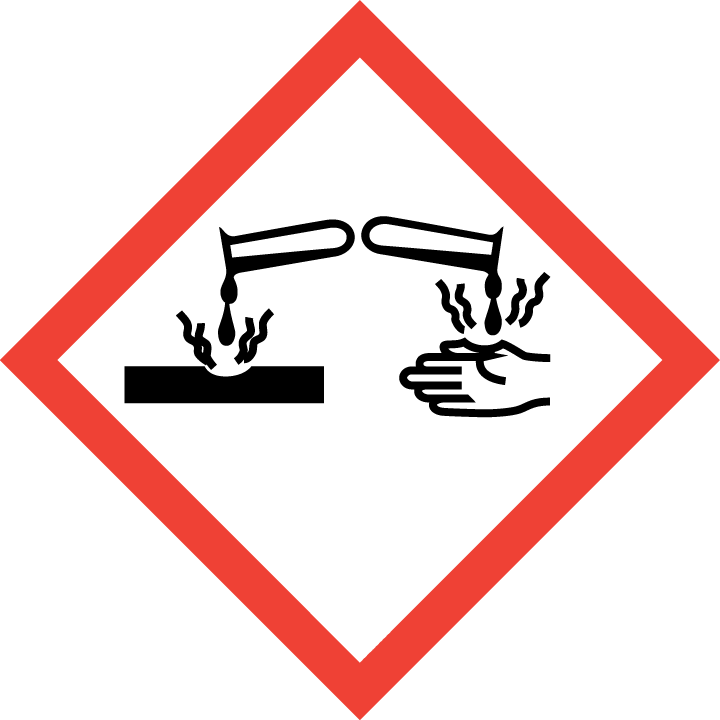
- Signal Words
- Danger
- Hazard Statement(s)
- H315 Causes skin irritation.
- H318 Causes serious eye damage.
- H401 Toxic to aquatic life.
- H412 Harmful to aquatic life with long lasting effects.
- Precautionary Statement(s)
- Prevention:
- P264 Wash skin thoroughly after handling.
- P273 Avoid release to the environment.
- P280 Wear protective gloves/ eye protection/ face protection.
- Response:
- P302 + P352 IF ON SKIN: Wash with plenty of water.
- P305 + P351 + P338 + P310 IF IN EYES: Rinse cautiously with water for several minutes. Remove contact lenses, if present and easy to do. Continue rinsing. Immediately call a POISON CENTER/ doctor.
- P332 + P313 If skin irritation occurs: Get medical advice/ attention.
- P362 + P364 Take off contaminated clothing and wash it before reuse.
- Disposal:
- P501 Dispose of contents/ container to an approved waste disposal plant.
Primary route(s) of entry
- Primary route(s) of entry:Skin contact, Eye Contact
- Secondary Route of Entry: Inhilation
Human Health
- Inhalation
- Not classified as an inhalation hazard. Vapour generation is low because it is an aqueous detergent. Aerosol/mist could irritate the respiratory tract.
- Ingestion
- Not classified as an acute oral toxicity hazard. Swallowing may cause irritation of the mouth, throat and gastrointestinal tract; nausea/vomiting may occur.
- Eyes
- Causes serious eye damage; concentrated product can cause significant injury.
- Skin
- Causes skin irritation; repeated/prolonged contact may cause dryness or irritation.
Environment
Harmful to aquatic life with long-lasting effects (H412). Avoid release to the environment. Product is phosphate-free and biodegradable. Prevent uncontrolled discharge of concentrated product to drains, waterways or soil.
- Other Hazards
- None known.
3. Composition / Information on Ingredients
| Name | CAS No. | Content (w/w) | Classification |
|---|---|---|---|
| n-alkylbenzenesulfonic acid, sodium salts | 68411-30-3 | ≥ 10 - < 30 | |
| Dimethyldodecylamine oxide | 1643-20-5 | ≥ 3 - < 10 | |
| Sodium xylenesulphonate | 1300-72-7 | < 10 | |
| Alcohols, C12-14-secondary, ethoxylated | 84133-50-6 | ≥ 3 - < 10 |
4. First Aid Measures
- Ingestion
- After swallowing: immediately make victim drink water (two glasses at most).
- Consult a physician.
- Inhalation
- After inhalation: fresh air.
- Skin Contact
- In case of skin contact: Take off immediately all contaminated clothing. Rinse skin with water/ shower.
- Eye Contact
- After eye contact: rinse out with plenty of water.
- Immediately call in ophthalmologist.
- Remove contact lenses.
- Other Information
- General advice: Show this safety data sheet to the doctor in attendance.
- Most important symptoms and effects, both acute and delayed: The most important known symptoms and effects are described in the labelling (see section 2.2) and/or in section 11
- Protection of first-aiders: For personal protection see section 8.
- Notes to physician: No data available
5. Firefighting Measures
Suitable extinguishing equipment
- Fire
- Suitable extinguishing media:
- Water
- Foam
- Carbon dioxide (CO2)
- Dry powder
- Large Fire
- No information available
- HAZCHEM
- N/A
Special protective equipment and precautions for fire fighters
- Suitable extinguishing media: Water
- Foam
- Carbon dioxide (CO2)
- Dry powder
- Unsuitable extinguishing media: For this substance/mixture no limitations of extinguishing agents are given.
- Specific hazards during fire fighting: Combustible. Development of hazardous combustion gases or vapours possible in the event of fire.
- Hazardous combustion products:
- Carbon oxides
- Nitrogen oxides (NOx)
- Sulphur oxides
- Sodium oxides
- Specific extinguishing methods: Suppress (knock down) gases/vapours/mists with a water spray jet. Prevent fire extinguishing water from contaminating surface water or the ground water system.
- Special protective equipment for fire-fighters: Stay in danger area only with self-contained breathing apparatus. Prevent skin contact by keeping a safe distance or by wearing suitable protective clothing.
6. Accidental Release Measures
- Personal precautions, protective equipment and emergency procedures
- Advice for non-emergency personnel:
- Do not breathe vapours, aerosols.
- Avoid substance contact.
- Ensure adequate ventilation.
- Evacuate the danger area, observe emergency procedures, consult an expert.
- Advice for emergency responders:
- For personal protection see section 8.
- Environmental precautions
- Do not let product enter drains.
- Methods and materials for containment and clean up
- Cover drains. Collect, bind, and pump off spills.
- Observe possible material restrictions (see sections 7 and 10).
- Take up with liquid-absorbent material (e.g. Chemizorb® ). Dispose of properly. Clean up affected area.
7. Handling and Storage
- Precautions for safe handling
- For precautions see section 2.2.
- Hygiene measures: Immediately change contaminated clothing. Apply preventive skin protection. Wash hands and face after working with substance.
- Conditions for safe storage
- Further information on storage conditions: Tightly closed.
- Storage class: 10, Combustible liquids
- Recommended storage temperature: Recommended storage temperature see product label.
8. Exposure Controls / Personal Protection
Exposure Standards
- Engineering controls
- No data available
Personal protective equipment
- Eye and face protection
- Use equipment for eye protection tested and approved under appropriate government standards such as NIOSH (US) or EN 166(EU).
- Tightly fitting safety goggles
- Skin protection
- Hand protection
- Remarks: required
- Body protection
- protective clothing
- Respiratory protection
- required when vapours/aerosols are generated.
- Our recommendations on filtering respiratory protection are based on the following standards: DIN EN 143, DIN 14387 and other accompanying standards relating to the used respiratory protection system.
- Recommended Filter type: Filter type ABEK
- The entrepeneur has to ensure that maintenance, cleaning and testing of respiratory protective devices are carried out according to the instructions of the producer. These measures have to be properly documented.
9. Physical and Chemical Properties
General information
- Appearance
- Light yellow liquid
- Odour
- No data available
- pH
- 8.5
- Vapour Pressure
- No data available
- Density
- No data available
- Boiling Point
- No data available
- Melting Point
- No data available
- Solubility
- Water solubility: soluble (20 °C)
- Specific Gravity of Density
- No data available
- Flash Point
- No data available
- Flammable (Explosive) Limits
- No data available
- Ignition Temperature
- No data available
10. Stability and Reactivity
- Reactivity
- No data available
- Chemical stability
- The product is chemically stable under standard ambient conditions (room temperature) .
- Possibility of hazardous reactions
- No data available
- Conditions to avoid
- No data available
- Incompatible materials
- Strong oxidizing agents
11. Toxicological Information
- Acute effects
- Mixture
- Oral: No data available
- Acute toxicity estimate Inhalation - 4 h - > 5 mg/l - dust/mist(Calculation method)
- Symptoms: Possible symptoms:, mucosal irritations
- Dermal: No data available
- Eye contact
- Serious eye damage/eye irritation
- Remarks: Mixture causes serious eye damage.
- Skin contact
- Skin corrosion/irritation
- Remarks: Mixture causes skin irritation.
- Ingestion
- No data available
- Inhalation
- No data available
- Chronic effects
- No data available
- Toxicity and irritation
- To the best of our knowledge, the chemical, physical, and toxicological properties have not been thoroughly investigated.
- Other dangerous properties can not be excluded.
- Handle in accordance with good industrial hygiene and safety practice.
- Components
- n-alkylbenzenesulfonic acid, sodium salts
- Acute toxicity: LD50 Oral - Rat - male and female - 1,080 mg/kg (OECD Test Guideline 401)
- Inhalation: No data available
- LD50 Dermal - Rat - male and female - > 2,000 mg/kg (OECD Test Guideline 402)
- Skin corrosion/irritation: Skin - Rabbit - Result: irritating - 4 h (OECD Test Guideline 404)
- Serious eye damage/eye irritation: Eyes - Rabbit - Result: Irreversible effects on the eye - 72 h (OECD Test Guideline 405)
- Respiratory or skin sensitization: Maximisation Test - Guinea pig - Result: Does not cause skin sensitisation. (OECD Test Guideline 406)
- Germ cell mutagenicity: Test Type: In vitro mammalian cell gene mutation test - Result: negative; Test Type: Ames test - Test system: Salmonella typhimurium - Result: negative; Test Type: Mutagenicity (mammal cell test): chromosome aberration. - Result: Positive results were obtained in some in vitro tests.; Species: Mouse - male - Bone marrow - Result: negative - Remarks: (ECHA)
- Carcinogenicity: No data available
- Reproductive toxicity: No data available
- Specific target organ toxicity - single exposure: No data available
- Aspiration hazard: No data available
- Dimethyldodecylamine oxide
- Acute toxicity: LD50 Oral - Rat - male and female - 1,064 mg/kg (OECD Test Guideline 401)
- Inhalation: No data available
- Dermal: No data available
- Skin corrosion/irritation: Skin - Rabbit - Result: Irritating to skin. (OECD Test Guideline 404)
- Serious eye damage/eye irritation: Eyes - Rabbit - Result: Risk of serious damage to eyes. (OECD Test Guideline 405)
- Respiratory or skin sensitization: Buehler Test - Guinea pig - Result: negative (OECD Test Guideline 406)
- Germ cell mutagenicity: Test Type: In vitro mammalian cell gene mutation test - Test system: Chinese hamster lung cells - Result: negative - Remarks: (ECHA); Test Type: Ames test - Test system: S. typhimurium - Result: negative; Test Type: Mutagenicity (mammal cell test): micronucleus. - Test system: Human lymphocytes - Result: negative
- Carcinogenicity: No data available
- Reproductive toxicity: No data available
- Specific target organ toxicity - single exposure: No data available
- Aspiration hazard: No data available
- Sodium xylenesulphonate
- Acute toxicity: LD50 Oral - Rat - male and female - > 7,000 mg/kg (OECD Test Guideline 401)
- LC50 Inhalation - Rat - male and female - 3.8 h - > 6.41 mg/l - dust/mist (OECD Test Guideline 403)
- LD50 Dermal - Rabbit - male and female - > 2,000 mg/kg (OECD Test Guideline 402)
- Skin corrosion/irritation: Skin - Rabbit - Result: No skin irritation - 24 h
- Serious eye damage/eye irritation: Eyes - Rabbit - Result: Irritating to eyes. - Remarks: (ECHA)
- Respiratory or skin sensitization: No data available
- Germ cell mutagenicity: Test Type: Hamster - Test system: ovary - Result: negative
- Carcinogenicity: No data available
- Reproductive toxicity: No data available
- Specific target organ toxicity - single exposure: No data available
- Specific target organ toxicity - repeated exposure: No data available
- Aspiration hazard: No data available
- Alcohols, C12-14-secondary, ethoxylated
- Acute toxicity: Acute toxicity estimate Oral - 500.1 mg/kg (Expert judgement)
- LC50 Inhalation - Rat - 4 h - 1.06 mg/l - dust/mist - Remarks: (External MSDS)
- LD50 Dermal - Rat - male and female - > 14,000 mg/kg - Remarks: (External MSDS)
- Skin corrosion/irritation: Remarks: Causes skin irritation. The value is given in analogy to the following substances: Mixed linear and branched C14-15 alcohols ethoxylated, reaction product with epichlorohydrin
- Serious eye damage/eye irritation: Remarks: Causes serious eye damage.
- Respiratory or skin sensitization: No data available
- Germ cell mutagenicity: No data available
- Carcinogenicity: No data available
- Reproductive toxicity: No data available
- Specific target organ toxicity - single exposure: No data available
- Specific target organ toxicity - repeated exposure: No data available
- Aspiration hazard: No data available
12. Ecological Information
- Ecotoxicity
- Components:
- n-alkylbenzenesulfonic acid, sodium salts:
- Toxicity to fish: LC50 (Lepomis macrochirus (Bluegill sunfish)): 1.67 mg/l
- End point: mortality
- Exposure time: 96 h
- Test Type: static test
- Analytical monitoring: yes
- Method: US-EPA
- GLP: yes
- Toxicity to daphnia and other aquatic invertebrates: EC50 (Daphnia magna (Water flea)): 2.9 mg/l
- Exposure time: 48 h
- Test Type: static test
- Analytical monitoring: yes
- Method: OECD Test Guideline 202
- GLP: yes
- Toxicity to algae/aquatic plants: ErC50 (Pseudokirchneriella subcapitata (green algae)): 235 mg/l
- Exposure time: 72 h
- Test Type: static test
- Remarks: (ECHA)
- Toxicity to fish (Chronic toxicity): NOEC (Oncorhynchus tshawytscha (chinook salmon)): 0.23 mg/l
- End point: mortality
- Exposure time: 72 d
- Test Type: flow-through test
- Analytical monitoring: yes
- Method: OECD Test Guideline 210
- GLP: yes
- Toxicity to daphnia and other aquatic invertebrates (Chronic toxicity): NOEC (Daphnia magna (Water flea)): 1.18 mg/l
- End point: reproduction rate
- Exposure time: 21 d
- Test Type: flow-through test
- Analytical monitoring: yes
- Method: OECD Test Guideline 211
- Dimethyldodecylamine oxide:
- Toxicity to fish: LC50 (Danio rerio (zebra fish)): 31.8 mg/l
- End point: mortality
- Exposure time: 96 h
- Test Type: semi-static test
- Method: OECD Test Guideline 203
- Toxicity to daphnia and other aquatic invertebrates: EC50 (Daphnia magna (Water flea)): 3.9 mg/l
- End point: Immobilization
- Exposure time: 48 h
- Test Type: static test
- Method: OECD Test Guideline 202
- GLP: yes
- Toxicity to algae/aquatic plants: ErC50 (Pseudokirchneriella subcapitata (green algae)): 0.2 mg/l
- Exposure time: 72 h
- Test Type: static test
- Method: OECD Test Guideline 201
- M-Factor (Acute aquatic toxicity): 1
- Toxicity to fish (Chronic toxicity): LC50 (Pimephales promelas (fathead minnow)): 0.87 mg/l
- End point: mortality
- Exposure time: 120 d
- Test Type: flow-through test
- Analytical monitoring: yes
- Method: US-EPA
- Toxicity to daphnia and other aquatic invertebrates (Chronic toxicity): NOEC (Daphnia magna (Water flea)): 0.7 mg/l
- Exposure time: 21 d
- Test Type: flow-through test
- Analytical monitoring: yes
- Method: OECD Test Guideline 211
- Toxicity to microorganisms: EC10 (Pseudomonas putida): 80 mg/l
- Exposure time: 18 h
- Ecotoxicology Assessment
- Chronic aquatic toxicity: Toxic to aquatic life with long lasting effects.
- Alcohols, C12-14-secondary, ethoxylated:
- Toxicity to fish: LC50 (Pimephales promelas (fathead minnow)): 3.2 - 3.6 mg/l
- Exposure time: 96 h
- Test Type: static test
- Remarks: (External MSDS)
- Toxicity to daphnia and other aquatic invertebrates: EC50 (Daphnia magna (Water flea)): 7.3 mg/l
- Exposure time: 48 h
- Test Type: static test
- Remarks: (External MSDS)
- Toxicity to microorganisms: EC50 (Bacteria): > 1,000 mg/l
- Exposure time: 16 h
- Remarks: (External MSDS)
- Persistence and degradability
- Components:
- n-alkylbenzenesulfonic acid, sodium salts:
- Biodegradability: aerobic
- Inoculum: activated sludge, non-adapted
- Concentration: 34.3 mg/l
- Result: Readily biodegradable.
- Biodegradation: 85 %
- Exposure time: 29 d
- Method: OECD Test Guideline 301B
- GLP: yes
- Dimethyldodecylamine oxide:
- Biodegradability: aerobic
- Inoculum: activated sludge
- Concentration: 20 mg/l
- Result: Readily biodegradable.
- Biodegradation: 95.27 %
- Exposure time: 28 d
- Method: OECD Test Guideline 301B
- Sodium xylenesulphonate:
- Biodegradability: aerobic
- Inoculum: activated sludge, non-adapted
- Result: Readily biodegradable.
- Biodegradation: 83 - 85 %
- Exposure time: 28 d
- Method: OECD Test Guideline 301B
- GLP: yes
- Alcohols, C12-14-secondary, ethoxylated:
- Biodegradability: Result: Readily biodegradable.
- Biodegradation: > 60 %
- Exposure time: 28 d
- Method: OECD Test Guideline 301F
- Remarks: (External MSDS)
- Bioaccumulative potential
- Components:
- n-alkylbenzenesulfonic acid, sodium salts:
- Bioaccumulation: Species: Pimephales promelas (fathead minnow)
- Bioconcentration factor (BCF): 87
- Partition coefficient: n-octanol/water: log Pow: 1.4 (23 °C)
- pH: 6.1
- Method: OECD Test Guideline 123
- Sodium xylenesulphonate:
- Partition coefficient: n-octanol/water: log Pow: -3.12 (20 °C)
- pH: 11.96
- Method: Regulation (EC) No. 440/2008, Annex, A.8
- GLP: yes
- Alcohols, C12-14-secondary, ethoxylated:
- Bioaccumulation: Bioconcentration factor (BCF): 29
- Remarks: No bioaccumulation is to be expected (log Pow <= 4).
- (External MSDS)
- Partition coefficient: n-octanol/water: log Pow: 2.72
- Remarks: Bioaccumulation is not expected.
- (External MSDS)
- Other adverse effects
- Mobility in soil
- No data available
- Other adverse effects
- Components:
- n-alkylbenzenesulfonic acid, sodium salts:
- Results of PBT and vPvB assessment: Substance does not meet the criteria for PBT or vPvB according to Regulation (EC) No 1907/2006, Annex XIII.
- Endocrine disrupting properties
- No data available
13. Disposal Considerations
General information
Waste from residues: Waste material must be disposed of in accordance with the national and local regulations. Leave chemicals in original containers. No mixing with other waste. Handle uncleaned containers like the product itself.
14. Transport Information
ADG label required
- HAZCHEM
- N/A
- UN Number
- Not applicable
- Proper shipping name
- Not applicable
- Transport hazard class
- Not applicable
- Packing group
- Not applicable
- Environmental hazard
- Not applicable
- Special precautions for users
- Not classified as dangerous in the meaning of transport regulations.
- Additional information
- National Regulations
- ADG
- Not regulated as a dangerous good
- Subsidiary risk: Not applicable
- Labels: Not applicable
- Hazchem Code: Not applicable
- International Regulations
- IATA-DGR
- Not regulated as a dangerous good
- UN/ID No.: Not applicable
- Proper shipping name: Not applicable
- Class: Not applicable
- Subsidiary risk: Not applicable
- Packing group: Not applicable
- Labels: Not applicable
- Packing instruction (cargo aircraft): Not applicable
- Packing instruction (passenger aircraft): Not applicable
- IMDG-Code
- Not regulated as a dangerous good
- UN number: Not applicable
- Proper shipping name: Not applicable
- Class: Not applicable
- Subsidiary risk: Not applicable
- Packing group: Not applicable
- Labels: Not applicable
- EmS Code: Not applicable
- Marine pollutant: Not applicable
- Transport in bulk according to Annex II of MARPOL 73/78 and the IBC Code
- Not applicable for product as supplied.
15. Regulatory Information
- Poisons Schedule Number
- Therapeutic Goods (Poisons Standard) Instrument: No poison schedule number allocated
- (Please use the original publication to check for specific uses, specific conditions or threshold limits that might apply for this chemical)
- Other Information
- Safety, health and environmental regulations/legislation specific for the substance or mixture
- Prohibition/Licensing Requirements: There is no applicable prohibition, authorisation and restricted use requirements, including for carcinogens referred to in Schedule 10 of the model WHS Act and Regulations.
- National Code of Practice for Chemicals of Security Concern: Not listed
16. Other Information
- SDS preparation date
- 18 August 2026
- Comments
- Revision Date: 26.03.2026
- Other information: The information is believed to be correct but is not exhaustive and will be used solely as a guideline, which is based on current knowledge of the chemical substance or mixture and is applicable to appropriate safety precautions for the product. It does not represent any guarantee of the properties of the product.
- Full text of other abbreviations
- AIIC - Australian Inventory of Industrial Chemicals; ANTT - National Agency for Transport by Land of Brazil; ASTM - American Society for the Testing of Materials; bw - Body weight; CMR - Carcinogen, Mutagen or Reproductive Toxicant; DIN - Standard of the German Institute for Standardisation; DSL - Domestic Substances List (Canada); ECx - Concentration associated with x% response; ELx - Loading rate associated with x% response; EmS - Emergency Schedule; ENCS - Existing and New Chemical Substances (Japan); ErCx - Concentration associated with x% growth rate response; ERG - Emergency Response Guide; GHS - Globally Harmonised System; GLP - Good Laboratory Practice; IARC - International Agency for Research on Cancer; IATA - International Air Transport Association; IBC - International Code for the Construction and Equipment of Ships carrying Dangerous Chemicals in Bulk; IC50 - Half maximal inhibitory concentration; ICAO - International Civil Aviation Organization; IECSC - Inventory of Existing Chemical Substances in China; IMDG - International Maritime Dangerous Goods; IMO - International Maritime Organisation; ISHL - Industrial Safety and Health Law (Japan); ISO - International Organisation for Standardisation; KECI - Korea Existing Chemicals Inventory; LC50 - Lethal Concentration to 50 % of a test population; LD50 - Lethal Dose to 50% of a test population (Median Lethal Dose); MARPOL - International Convention for the Prevention of Pollution from Ships; MERCOSUR - The Agreement for the Facilitation of the Transport of Dangerous Goods; n.o.s. - Not Otherwise Specified; Nch - Chilean Norm; NO(A)EC - No Observed (Adverse) Effect Concentration; NO(A)EL - No Observed (Adverse) Effect Level; NOELR - No Observable Effect Loading Rate; NOM - Official Mexican Norm; NTP - National Toxicology Program; NZIoC - New Zealand Inventory of Chemicals; OECD - Organisation for Economic Co-operation and Development; OPPTS - Office of Chemical Safety and Pollution Prevention; PBT - Persistent, Bioaccumulative and Toxic substance; PICCS - Philippines Inventory of Chemicals and Chemical Substances; (Q)SAR - (Quantitative) Structure Activity Relationship; REACH - Regulation (EC) No 1907/2006 of the European Parliament and of the Council concerning the Registration, Evaluation, Authorisation and Restriction of Chemicals; SADT - Self-Accelerating Decomposition Temperature; SDS - Safety Data Sheet; TCSI - Taiwan Chemical Substance Inventory; TDG - Transportation of Dangerous Goods; TECI - Thailand Existing Chemicals Inventory; TSCA - Toxic Substances Control Act (United States); UN - United Nations; UNRTDG - United Nations Recommendations on the Transport of Dangerous Goods; vPvB - Very Persistent and Very Bioaccumulative; WHMIS - Workplace Hazardous Materials Information System
- References
- Merch Safety Data Sheet "Liquinox(r) phosphate-free liquid detergent". 26/03/2026 https://www.sigmaaldrich.com/AU/en/sds/aldrich/z742916?userType=anonymous.