
Safety Data Sheets / Congo Red, C.I. 22120
Safety Data Sheet
Congo Red, C.I. 22120
1. Identification
Product Identifiers
- Product Name
- Congo Red, C.I. 22120
- Other Names
- Synonyms
- Product Number(s)
- C0931; C0935; 11103
- CAS Number
- 573-58-0
Recommended use of the chemical and restriction on use
Laboratory reagent
Company Details
ProSciTech Pty Ltd
11 Carlton Street
KIRWAN QLD 4817
Australia
(07) 4773 9444
pst@proscitech.com
proscitech.com.au
11 Carlton Street
KIRWAN QLD 4817
Australia
(07) 4773 9444
pst@proscitech.com
proscitech.com.au
Emergency Contact Details
ProSciTech Pty Ltd
11 Carlton Street
KIRWAN QLD 4817
Australia
(07) 4773 9444
pst@proscitech.com
proscitech.com.au
11 Carlton Street
KIRWAN QLD 4817
Australia
(07) 4773 9444
pst@proscitech.com
proscitech.com.au
2. Hazards Identification
Classification of the substance or mixture
Solid
Label Elements
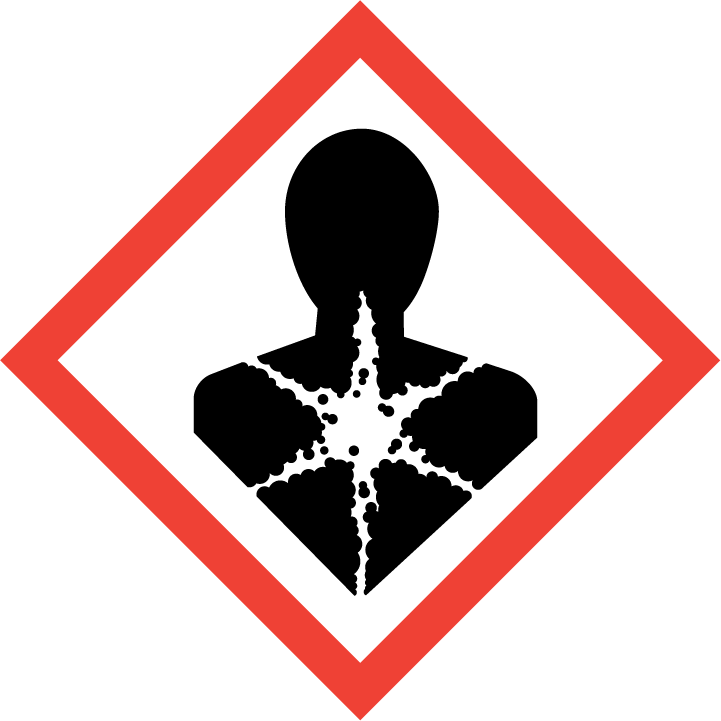
- Signal Words
- None
- Hazard Statement(s)
- Carcinogenicity: Category 1B H350 May cause cancer.
- Toxic to Reproduction: Category 2 H361 Suspected of damaging fertility or the unborn child.
- Precautionary Statement(s)
- P201 Obtain special instructions before use
- P202 Do not handle until all safety precautions have been read and understood.
- P281 Use personal protective equipment as required.
- P308±P313 IF exposed or concerned: Get medical advice/attention.
- P405 Store locked up.
- P501 Dispose of contents/container to an approved waste disposal plant.
Primary route(s) of entry
No data
Human Health
- Inhalation
- May be harmful by inhalation. Avoid breathing dust, vapours or mists.
- Ingestion
- May be harmful by ingestion
- Eyes
- May cause eye irritation - The use of a face shield, chemical goggles or safety glasses
- Skin
- May be harmful by skin absorption - Avoid contact with skin, eyes and clothing
Environment
No information available
3. Composition / Information on Ingredients
| Name | CAS No. | Content (w/w) | Classification |
|---|---|---|---|
| Congo Red | 573-58-0 | 100% | Not Available |
4. First Aid Measures
- Ingestion
- Rinse mouth thoroughly with water immediately, repeat until all traces of product have been removed. DO NOT INDUCE VOMITING. Seek medical advice if effects persist.
- Inhalation
- If inhaled, remove from contaminated area to fresh air immediately. Apply artificial respiration if not breathing. If breathing is difficult, give oxygen. Get medical aid if cough or other symptoms appear.
- Skin Contact
- Immediately remove contaminated clothing and wash affected area with water for at least 15 minutes. Ensure contaminated clothing is washed before re-use. Seek medical advice if concerned.
- Eye Contact
- Immediately irrigate with copious quantity of water for at least 15 minutes. Eyelids to be held open. In all cases of eye contamination it is a sensible precaution to seek medical advice.
- Other Information
- Maintain eyewash fountain and safety shower in work area.
- Treat symptomatically based on judgement of doctor and individual reactions of the patient
5. Firefighting Measures
Suitable extinguishing equipment
- Fire
- Small fire: Use dry chemical, CO₂ or water spray.
- Large fire: Use water spray, fog or foam - Do NOT use water jets
- HAZCHEM
- May evolve irritating and toxic fumes in fire including nitrogen and sulphur oxides. May burn but do not ignite readily.
Special protective equipment and precautions for fire fighters
- Wear SCBA and chemical splash suit. Fully encapsulating, gas-tight suits should be worn for maximum
- protection. Structural firefighter's uniform is NOT effective for these materials.
6. Accidental Release Measures
- Personal precautions, protective equipment and emergency procedures
- Avoid inhalation, contact with skin, eyes and clothing. Use personal protective equipment listed in Section 8
- Environmental precautions
- Whatever cannot be saved for recovery or recycling should be handled as hazardous waste and disposed of according to relevant local, state and federal government regulations.
- Methods and materials for containment and clean up
- Sweep up (avoid generating dust) and remove to a suitable, clearly labelled container for disposal in accordance with local regulations.
7. Handling and Storage
- Precautions for safe handling
- Wash hands and face thoroughly after working with material. Avoid generation or accumulation of dusts. Avoid prolonged or repeated contact with skin, eyes and clothing. In case of insufficient ventilation, wear suitable respiratory equipment. Use local exhaust extraction.
- Conditions for safe storage
- Store away from oxidising agents. Keep container tightly closed and in a cool, dry, well-ventilated place, away from direct sunlight and other sources of heat or ignition.
8. Exposure Controls / Personal Protection
Exposure Standards
- Engineering controls
- No exposure standards have been established for this product by Safe Work Australia, however, the TWA exposure standard for dusts/mists not otherwise specified is 10 mg/m3. All atmospheric
- contamination should be kept to as low a level as is workable.
- In industrial situations maintain the concentrations values below the TWA. This may be achieved by process modification, use of local exhaust ventilation, capturing substances at the source, or other
- methods. These methods should be used in preference to personal protective equipment.
Personal protective equipment
- Eye and face protection
- The use of a face shield, chemical goggles or safety glasses with side shield protection as appropriate. Must comply with Australian Standards AS 1337 and be selected and used in accordance with AS 1336.
- Skin protection
- Personal protective equipment should not solely be relied upon to control risk and should only be used when all other reasonably practicable control measures do not eliminate or sufficiently minimise risk. Guidance in selecting personal protective equipment can be obtained from Australian, Australian/New Zealand or other approved standards.
- Body protection
- Clean clothing or protective clothing should be worn, preferably with an apron. Clothing for protection against chemicals should comply with AS 3765 Clothing for Protection Against Hazardous Chemicals.
- Respiratory protection
- Where ventilation is not adequate, respiratory protection may be required. Avoid breathing dust, vapours or mists. Respiratory protection should comply with AS 1716 - Respiratory Protective Devices and be selected in accordance with AS 1715 - Selection, Use and Maintenance of Respiratory Protective Devices. Filter capacity and respirator type depends on exposure levels. In event of emergency or planned entry into unknown concentrations a positive pressure, full-facepiece SCBA should be used. If respiratory protection is required, institute a complete respiratory protection program including selection, fit testing, training, maintenance and inspection.
9. Physical and Chemical Properties
General information
- Appearance
- Solid brownish powder
- Odour
- Odourless
- pH
- ~ 6.7 (10 g/l, H2O, 20 °C)
- Vapour Pressure
- Not available
- Density
- Not available
- Boiling Point
- Not available
- Melting Point
- >360 °C
- Solubility
- Soluble (25 g/l @ 20 °C) Soluble in alcohol. Very slightly soluble in acetone. Insoluble in ether.
- Flammable (Explosive) Limits
- Combustible
10. Stability and Reactivity
- Reactivity
- Will not occur
- Chemical stability
- Stable under normal use conditons. Decomposes on exposure to acid fumes and at elevated temperatures.
- Possibility of hazardous reactions
- Oxides of carbon, oxides of nitrogen, oxides of sulphur, ammonia fumes and nitrogen.
- Conditions to avoid
- Incompatible materials, excess heat, dust generation, high temperatures.
- Incompatible materials
- Strong oxidising agents, strong reducing agents, strong acids.
11. Toxicological Information
- Acute effects
- Oral: LD50 (rat): 143 mg/kg; LDL0 (human): 143 mg/kg
- Eye contact
- May cause eye irritation
- Skin contact
- May be harmful by skin absorption. May cause skin irritation, sensitisation, an alleric reaction, which becomes evident upon reexposure to this material.
- Ingestion
- May be harmful by ingestion. May cause gastrointestinal irritation with nausea, vomiting and diarrhea.
- May also affect central nervous system, respiration and vascular system.
- Inhalation
- May be harmful by inhalation. May be irritating to mucous membranes and upper respiratory tract.
- Toxic effect on lungs.
- Toxicity and irritation
- May cause cancer. May cause reproductive and fetal effects (based upon animal experimental data).
- May affect genetic material (based upon animal experimental data).
12. Ecological Information
- Ecotoxicity
- Quantitative data on the ecological effect of this product are not available.
- Persistence and degradability
- No persistence/degradability data available for this product
- Bioaccumulative potential
- No further data available
- Other adverse effects
- No further data available
13. Disposal Considerations
General information
Whatever cannot be saved for recovery or recycling should be handled as hazardous waste and disposed of according to relevant local, state and federal government regulations.
14. Transport Information
ADG label required
- HAZCHEM
- May evolve irritating and toxic fumes in fire including nitrogen and sulphur oxides. May burn but do not ignite readily.
- UN Number
- Not available
- Proper shipping name
- Not available
- Transport hazard class
- Not available
- Packing group
- Not available
- Environmental hazard
- Not available
- Special precautions for users
- Not available
- Additional information
- Not classified as a Dangerous Good according to the Australian Code for the Transport of Dangerous Goods by Road and Rail.
15. Regulatory Information
- Poisons Schedule Number
- S7
- Other Information
- Listed in the Australian Inventory of Chemical Substances (AICS). Not listed under WHS Regulation 2011, Schedule 10 - Prohibited carcinogens, restricted carcinogens and restricted hazardous chemicals.
16. Other Information
- SDS preparation date
- 27 November 2024
- Comments
- All information provided in this data sheet or by our technical representatives is compiled from the best knowledge available to us. However, since data, safety standards and government regulations are subject to change and the conditions of handling and use, or misuse, are beyond our control, we make no warranty either expressed or implied, with respect to the completeness or accuracy to the information contained herein. Chem-Supply accepts no responsibility whatsoever for its accuracy or for any results that may be obtained by customers from using the data and disclaims all liability for reliance on information provided in this data sheet or by our technical representatives.
- References
- 'Standard for the Uniform Scheduling of Medicines and Poisons .', Commonwealth of Australia.
- Lewis, Richard J. Sr. 'Hawley's Condensed Chemical Dictionary 13th. Ed.', Rev., John Wiley and Sons, Inc., NY, 1997.
- National Road Transport Commission, 'Australian Code for the Transport of Dangerous Goods by Road and Rail 7th. Ed.', 2007.
- Safe Work Australia, 'National Code of Practice fot the Preparation of Safety Data Sheets for Hazardous Chemicals', 2011.
- Standards Australia, 'SAA/SNZ HB 76:2010 Dangerous Goods - Initial Emergency Response Guide', Standards Australia/Standards New Zealand, 2010.
- Safe Work Australia, 'Approved Criteria for Classifying Hazardous Substances [NOHSC:1008 (2004)]'.
- Safe Work Australia, 'Hazardous Chemical Information System, 2005'.
- Safe Work Australia, 'National Code of Practice for the Labelling of Safe Work Hazardous Substances (2011)'.
- Safe Work Australia, 'National Exposure Standards for Atmospheric Contaminants in the Occupational
- Environment [NOHSC:1003(1995) 3rd Edition]'