
Safety Data Sheets / Circuitworks Silver Conductive Epoxy - Hardener
Safety Data Sheet
Circuitworks Silver Conductive Epoxy - Hardener
1. Identification
Product Identifiers
- Product Name
- Circuitworks Silver Conductive Epoxy - Part B
- Other Names
- Silver conductive epoxy
- Product Number(s)
- CW2400, CW2400BLK PART B, CW2400J, PEL16043,16043
Recommended use of the chemical and restriction on use
Where and restrictions (eg. Laboratory use.)
Company Details
ProSciTech Pty Ltd
11 Carlton Street
KIRWAN QLD 4817
Australia
(07) 4773 9444
pst@proscitech.com
proscitech.com.au
11 Carlton Street
KIRWAN QLD 4817
Australia
(07) 4773 9444
pst@proscitech.com
proscitech.com.au
Emergency Contact Details
ProSciTech Pty Ltd
11 Carlton Street
KIRWAN QLD 4817
Australia
(07) 4773 9444
pst@proscitech.com
proscitech.com.au
11 Carlton Street
KIRWAN QLD 4817
Australia
(07) 4773 9444
pst@proscitech.com
proscitech.com.au
2. Hazards Identification
Classification of the substance or mixture
- ACUTE TOXICITY (dermal) - Category 3
- Percentage of the mixture consisting of ingredient(s) of unknown toxicity: 100%
Label Elements
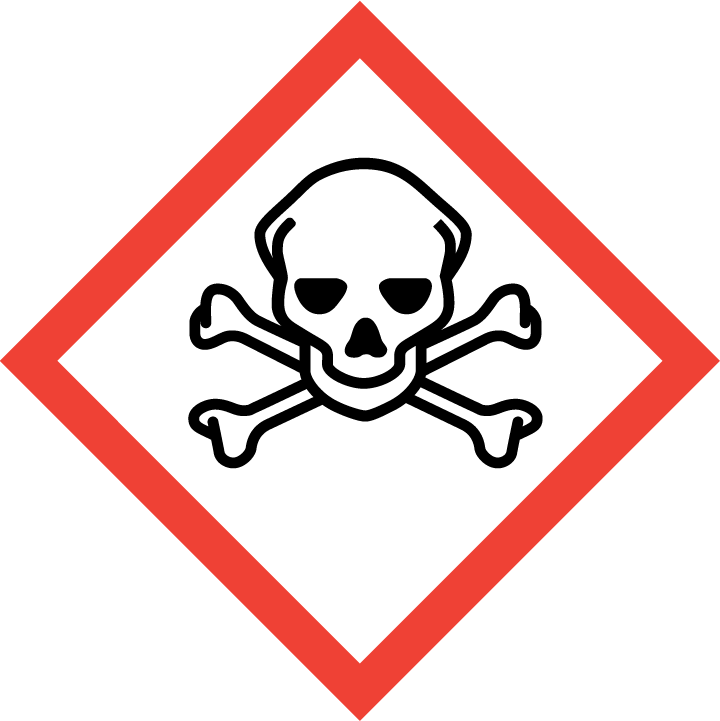
- Signal Words
- None
- Hazard Statement(s)
- Toxic in contact with skin.
- Precautionary Statement(s)
- Prevention: Wear protective gloves. Wear protective clothing.
- Response: IF ON SKIN: Take off immediately all contaminated clothing and wash it before reuse. Wash with plenty of soap and water. Call a POISON CENTER or physician if you feel unwell.
- Storage: Store locked up.
- Disposal: Dispose of contents and container in accordance with all local, regional, national and international regulations. : None known.
Primary route(s) of entry
Non Stated
Human Health
- Inhalation
- Non Stated
- Ingestion
- Non Stated
- Eyes
- Non Stated
- Skin
- Non Stated
Environment
Non Stated
3. Composition / Information on Ingredients
| Name | CAS No. | Content (w/w) | Classification |
|---|---|---|---|
| 3,6-diazaoctanethylenediamin | 112-24-3 | ≤6.8 | Not Available |
4. First Aid Measures
- Ingestion
- Wash out mouth with water. Remove dentures if any. Remove victim to fresh air and keep at rest in a position comfortable for breathing. If material has been swallowed and the exposed person is conscious, give small quantities of water to drink. Stop if the exposed person feels sick as vomiting may be dangerous. Do not induce vomiting unless directed to do so by medical personnel. If vomiting occurs, the head should be kept low so that vomit does not enter the lungs. Get medical attention. Never give anything by mouth to an unconscious person. If unconscious, place in recovery position and get medical attention immediately. Maintain an open airway. Loosen tight clothing such as a collar, tie, belt or waistband.
- Inhalation
- Remove victim to fresh air and keep at rest in a position comfortable for breathing. If not breathing, if breathing is irregular or if respiratory arrest occurs, provide artificial respiration or oxygen by trained personnel. It may be dangerous to the person providing aid to give mouth-to-mouth resuscitation. Get medical attention. If unconscious, place in recovery position and get medical attention immediately. Maintain an open airway. Loosen tight clothing such as a collar, tie, belt or waistband. In case of inhalation of decomposition products in a fire, symptoms may be delayed. The exposed person may need to be kept under medical surveillance for 48 hours.
- Skin Contact
- Wash with plenty of soap and water. Remove contaminated clothing and shoes. Wash contaminated clothing thoroughly with water before removing it, or wear gloves. Continue to rinse for at least 10 minutes. Get medical attention. If necessary, call a poison centre or physician. Wash clothing before reuse. Clean shoes thoroughly before reuse.
- Eye Contact
- Immediately flush eyes with plenty of water, occasionally lifting the upper and lower eyelids. Check for and remove any contact lenses. Continue to rinse for at least 10 minutes. Get medical attention.
- Other Information
- Most important symptoms/effects, acute and delayed
- Potential acute health effects.
- Eye contact: May cause severe eye irritation.
- Inhalation: No known significant effects or critical hazards.
- Skin Contact: Toxic in contact with skin.
- Ingestion: Harmful if swallowed.
- Over-exposure signs/symptoms.
- Eye contact: irritation
- redness
- watering
- Inhalation: respiratory tract irritation
- coughing
- Skin Contact: pain or irritation
- redness
- blistering may occur
- Ingestion: stomach pains
- Indication of immediate medical attention and special treatment needed, if necessary:
- Notes to Physician: In case of inhalation of decomposition products in a fire, symptoms may be delayed. The exposed person may need to be kept under medical surveillance for 48 hours.
- Specific Treatments: No specific treatment.
- Protection of First-aiders: No action shall be taken involving any personal risk or without suitable training. It may be dangerous to the person providing aid to give mouth-to-mouth resuscitation. Wash contaminated clothing thoroughly with water before removing it, or wear gloves.
5. Firefighting Measures
Suitable extinguishing equipment
- Fire
- Use an extinguishing agent suitable for the surrounding fire.
Special protective equipment and precautions for fire fighters
- Promptly isolate the scene by removing all persons from the vicinity of the incident if there is a fire. No action shall be taken involving any personal risk or without suitable training.
- Fire-fighters should wear appropriate protective equipment and self-contained breathing apparatus (SCBA) with a full face-piece operated in positive pressure mode.
6. Accidental Release Measures
- Personal precautions, protective equipment and emergency procedures
- For Non-emergency Personnel: No action shall be taken involving any personal risk or without suitable training. Evacuate surrounding areas. Keep unnecessary and unprotected personnel from entering. Do not touch or walk through spilled material. Do not breathe vapour or mist. Provide adequate ventilation. Wear appropriate respirator when ventilation is inadequate. Put on appropriate personal protective equipment.
- For emergency responders: If specialised clothing is required to deal with the spillage, take note of any information in Section 8 on suitable and unsuitable materials. See also the information in "For nonemergency personnel".
- Environmental precautions
- Avoid dispersal of spilled material and runoff and contact with soil, waterways, drains and sewers. Inform the relevant authorities if the product has caused environmental pollution (sewers, waterways, soil or air).
- Methods and materials for containment and clean up
- Small Spill: Stop leak if without risk. Move containers from spill area. Dilute with water and mop up if water-soluble. Alternatively, or if water-insoluble, absorb with an inert dry material and place in an appropriate waste disposal container. Dispose of via a licensed waste disposal contractor.
- Large Spill: Stop leak if without risk. Move containers from spill area. Approach release from upwind. Prevent entry into sewers, water courses, basements or confined areas. Wash spillages into an effluent treatment plant or proceed as follows. Contain and collect spillage with non-combustible, absorbent material e.g. sand, earth, vermiculite or diatomaceous earth and place in container for disposal according to local regulations (see Section 13). Dispose of via a licensed waste disposal contractor. Contaminated absorbent material may pose the same hazard as the spilled product. Note: see Section 1 for emergency contact information and Section 13 for waste disposal
7. Handling and Storage
- Precautions for safe handling
- Protective Measures: Put on appropriate personal protective equipment (see Section 8). Do not get in eyes or on skin or clothing. Do not breathe vapour or mist. Do not ingest. Keep in the original container or an approved alternative made from a compatible material, kept tightly closed when not in use. Empty containers retain product residue and can be hazardous. Do not reuse container.
- Advice on General Occupational Hygiene: Eating, drinking and smoking should be prohibited in areas where this material is handled, stored and processed. Workers should wash hands and face before eating, drinking and smoking. Remove contaminated clothing and protective equipment before entering eating areas. See also Section 8 for additional information on hygiene measures
- Conditions for safe storage
- Store in accordance with local regulations. Store in original container protected from direct sunlight in a dry, cool and well-ventilated area, away from incompatible materials (see Section 10) and food and drink. Store locked up. Keep container tightly closed and sealed until ready for use. Containers that have been opened must be carefully resealed and kept upright to prevent leakage. Do not store in unlabeled containers. Use appropriate containment to avoid environmental contamination.
8. Exposure Controls / Personal Protection
Exposure Standards
| Material | TWA ppm | TWA mg/m³ | STEL ppm | STEL mg/m³ |
|---|---|---|---|---|
| 3,6-diazaoctanethylenediamin | 1ppm 8 hours | - | - |
- Engineering controls
- Good general ventilation should be sufficient to control worker exposure to airborne contaminants.
Personal protective equipment
- Eye and face protection
- Safety eyewear complying with an approved standard should be used when a risk assessment indicates this is necessary to avoid exposure to liquid splashes, mists, gases or dusts. If contact is possible, the following protection should be worn, unless the assessment indicates a higher degree of protection: safety glasses with sideshields.
- Skin protection
- Hand Protection: Chemical-resistant, impervious gloves complying with an approved standard should be worn at all times when handling chemical products if a risk assessment indicates this is necessary. Considering the parameters specified by the glove manufacturer, check during use that the gloves are still retaining their protective properties. It should be noted that the time to breakthrough for any glove material may be different for different glove manufacturers. In the case of mixtures, consisting of several substances, the protection time of the gloves cannot be accurately estimated.
- Other skin protection: Appropriate footwear and any additional skin protection measures should be selected based on the task being performed and the risks involved and should be approved by a specialist before handling this product.
- Body protection
- Personal protective equipment for the body should be selected based on the task being performed and the risks involved and should be approved by a specialist before handling this product.
- Respiratory protection
- Based on the hazard and potential for exposure, select a respirator that meets the appropriate standard or certification. Respirators must be used according to a respiratory protection program to ensure proper fitting, training, and other important aspects of use.
9. Physical and Chemical Properties
General information
- Appearance
- Liquid (paste)
- Odour
- Amine like.
- pH
- Not available.
- Vapour Pressure
- <0.013 kPa (<0.1 mm Hg) [room temperature]
- Density
- Not available.
- Boiling Point
- Not available.
- Melting Point
- Not available.
- Solubility
- Not available.
- Specific Gravity of Density
- Not available.
- Flash Point
- Closed cup: >93.3°C (>199.9°F) [Setaflash.]
- Flammable (Explosive) Limits
- Not available.
- Ignition Temperature
- Not available.
- Formula
- Not available.
10. Stability and Reactivity
- Reactivity
- No specific test data related to reactivity available for this product or its ingredients.
- Chemical stability
- The product is stable.
- Possibility of hazardous reactions
- Under normal conditions of storage and use, hazardous reactions will not occur.
- Conditions to avoid
- No specific data.
- Incompatible materials
- No specific data.
11. Toxicological Information
- Acute effects
- 3,6-diazaoctanethylenediamin LD50 Dermal Rabbit 805 mg/kg
- LD50 Oral Rat 2500 mg/kg
- Eye contact
- May cause severe eye irritation.
- Skin contact
- Toxic in contact with skin
- Ingestion
- Harmful if swallowed.
- Inhalation
- No known significant effects or critical hazards
- Toxicity and irritation
- Acute toxicity estimates
- Route ATE value
- Oral 2500 mg/kg
- Dermal 805 mg/kg
12. Ecological Information
- Ecotoxicity
- No known significant effects or critical hazards.
- Persistence and degradability
- Not available.
- Bioaccumulative potential
- Product/ingredient name LogPow BCF Potential
- 3,6-diazaoctanethylenediamin -1.66 to -1.4 - Low
- Other adverse effects
- No known significant effects or critical hazards.
13. Disposal Considerations
General information
The generation of waste should be avoided or minimized wherever possible. Disposal of this product, solutions and any by-products should at all times comply with the requirements of environmental protection and waste disposal legislation and any regional local authority requirements. Dispose of surplus and non-recyclable products via a licensed waste disposal contractor. Waste should not be disposed of untreated to the sewer unless fully compliant with the requirements of all authorities with jurisdiction. Waste packaging should be recycled. Incineration or landfill should only be considered when recycling is not feasible. This material and its container must be disposed of in a safe way. Care should be taken when handling emptied containers that have not been cleaned or rinsed out. Empty containers or liners may retain some product residues. Avoid dispersal of spilled material and runoff and contact with soil, waterways, drains and sewers.
14. Transport Information
ADG label required
- UN Number
- Not regulated.
- Proper shipping name
- Adhesive, sealants
- Transport hazard class
- N/a
- Packing group
- n/a
- Environmental hazard
- No
- Special precautions for users
- N/a
- Additional information
- Reportable quantity: 1333.3 lbs / 605.33 kg [39. 003 gal / 147. 64 L] Package sizes shipped in quantities less than the product reportable quantity are not subject to the RQ (reportable quantity) transportation requirements
15. Regulatory Information
- Poisons Schedule Number
- Not applicable.
- Other Information
- Nil
16. Other Information
- SDS preparation date
- 19 February 2026
- References
- SDS CIRCUITWORKS® CONDUCTIVE EPOXY - Part B (Hardener) chrome-extension://efaidnbmnnnibpcajpcglclefindmkaj/https://www.2spi.com/catalog/documents/05000-partB-CircuitWorks-CW2400-4-22-2015.pdf 11/13/2018