
Safety Data Sheets / Canada Balsam
Safety Data Sheet
Canada Balsam
1. Identification
Product Identifiers
- Product Name
- Canada Balsam
- Other Names
- Canada balsam for microscopy
- Product Number(s)
- CHEGT1682-100ML; GT1682
- CAS Number
- 8007-47-4
Recommended use of the chemical and restriction on use
Laboratory use.
Company Details
ProSciTech Pty Ltd
11 Carlton Street
KIRWAN QLD 4817
Australia
(07) 4773 9444
pst@proscitech.com
proscitech.com.au
11 Carlton Street
KIRWAN QLD 4817
Australia
(07) 4773 9444
pst@proscitech.com
proscitech.com.au
Emergency Contact Details
ProSciTech Pty Ltd
11 Carlton Street
KIRWAN QLD 4817
Australia
(07) 4773 9444
pst@proscitech.com
proscitech.com.au
11 Carlton Street
KIRWAN QLD 4817
Australia
(07) 4773 9444
pst@proscitech.com
proscitech.com.au
2. Hazards Identification
Classification of the substance or mixture
- H315 Skin Irr. 2
- H317 Skin Sens. 1
- H413 Aquatic Chronic 4
Label Elements
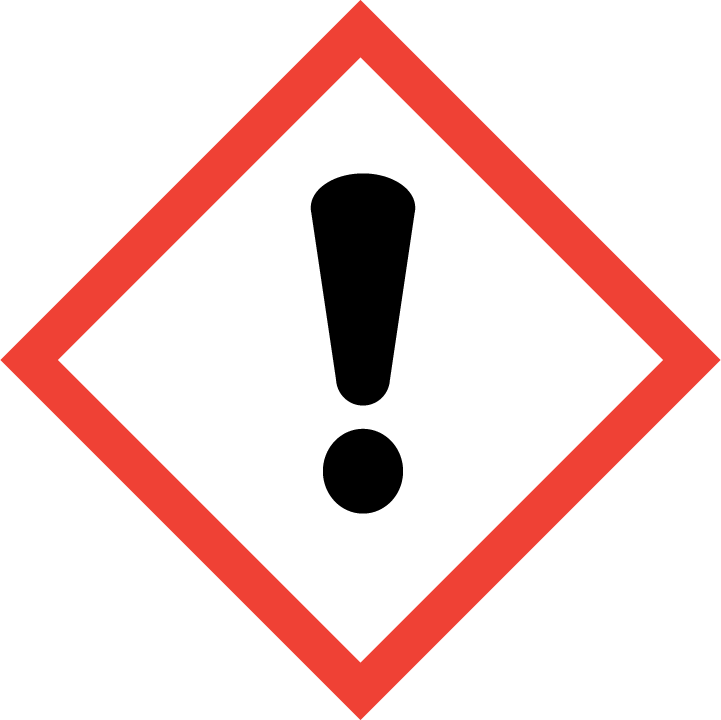
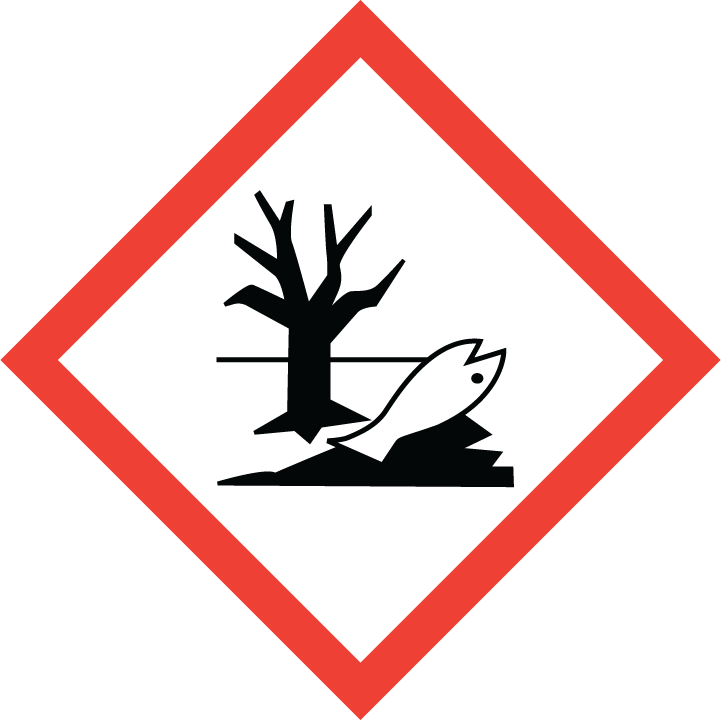
- Signal Words
- Danger
- Hazard Statement(s)
- H315 Causes skin irritation.
- H317 May cause an allergic skin reaction.
- H413 May cause long lasting harmful effects to aquatic life.
- Precautionary Statement(s)
- P273 Avoid release to the environment.
- P280 Wear protective gloves/protective clothing/eye protection/face protection.
- P302±P352 IF ON SKIN: wash with plenty of water.
Primary route(s) of entry
Not available.
Human Health
- Inhalation
- Not available.
- Ingestion
- Not available.
- Eyes
- Not available.
- Skin
- Not available.
Environment
Not available.
3. Composition / Information on Ingredients
| Name | CAS No. | Content (w/w) | Classification |
|---|---|---|---|
| Canada balsam | 8007-47-4 | - | H315, Skin Irr. 2H317, Skin Sens. 1H413, Aquatic Chronic 4 |
4. First Aid Measures
- Ingestion
- Consult a doctor. Wash out mouth with water. There may be irritation of the throat. There may be soreness and redness of the mouth and throat.
- Inhalation
- Consult a doctor. Remove casualty from exposure ensuring one's own safety whilst doing so. Exposure may cause coughing or wheezing. There may be irritation of the throat with a feeling of
- tightness in the chest.
- Skin Contact
- Consult a doctor. Remove all contaminated clothes and footwear immediately unless stuck to skin. Wash immediately with plenty of soap and water.
- There may be irritation and redness at the site of contact.
- Eye Contact
- Consult a doctor. Bathe the eye with running water for 15 minutes.
- The eyes may water profusely. There may be irritation and redness.The eyes may water profusely. There may be irritation and redness.
- Other Information
- Delayed effects can be expected after long-term exposure. Immediate effects can be expected after short-term exposure.
5. Firefighting Measures
Suitable extinguishing equipment
- Fire
- Suitable extinguishing media for the surrounding fire should be used.
- HAZCHEM
- In combustion emits toxic fumes.
Special protective equipment and precautions for fire fighters
Wear protective clothing to prevent contact with skin and eyes. Wear self-contained breathing apparatus.
6. Accidental Release Measures
- Personal precautions, protective equipment and emergency procedures
- Do not attempt to take action without suitable protective clothing - see section 8 of SDS. Do not create dust. Mark out the contaminated area with signs and prevent access to unauthorised personnel. Refer to section 8 of SDS for personal protection details.
- Environmental precautions
- Do not discharge into drains or rivers.
- Methods and materials for containment and clean up
- Transfer to closable, labelled salvage container for disposal by an appropriate method.
7. Handling and Storage
- Precautions for safe handling
- Avoid direct contact with the substance. Avoid the formation or spread of dust in the air. Ensure there is sufficient ventilation of the area.
- Conditions for safe storage
- Avoid contact with water or humidity. Keep container tightly closed. Store in cool, well ventilated area.
8. Exposure Controls / Personal Protection
Exposure Standards
- Engineering controls
- Ensure there is sufficient ventilation of the area.
Personal protective equipment
- Eye and face protection
- Ensure eye bath is to hand. Safety glasses.
- Skin protection
- Full contact:
- Glove material: Nitrile rubber
- Glove thickness: 0,11 mm
- Break through time: > 480 min
- The protective gloves to be used must comply with the specifications of EC Directive 89/686/EEC and the related standard EN374, for example KCL 741 Dermatril® L (full contact), KCL 741 Dermatril® L (splash contact).
- The breakthrough times stated above were determined by KCL in laboratory tests acc. to EN374 with samples of the recommended glove types.
- This recommendation applies only to the product stated in the safety data sheet<(>,<)> supplied by us and for the designated use. When dissolving in or mixing with other substances and under conditions deviating from those stated in EN374 please contact the supplier of CE-approved gloves (e.g. KCL GmbH, D-36124 Eichenzell, Internet: www.kcl.de).
- Body protection
- Protective clothing needs to be selected specifically for the workplace, depending on concentrations and quantities of the hazardous substances handled. The chemical resistance of the protective equipment should be enquired at the respective supplier.
- Flame retardant antistatic protective clothing.
- Respiratory protection
- Respiratory protective device with particle filter. Self-contained breathing apparatus must be available in case of emergency.
9. Physical and Chemical Properties
General information
- Appearance
- Yellow liquid.
- Odour
- Not available.
- pH
- Not available.
- Vapour Pressure
- Not available.
- Density
- Not available.
- Boiling Point
- Not available.
- Melting Point
- Not available.
- Solubility
- Not available.
- Specific Gravity of Density
- Not available.
- Flash Point
- Not available.
- Flammable (Explosive) Limits
- Not classified as explosive.
- Ignition Temperature
- Not available.
- Formula
- Not available.
10. Stability and Reactivity
- Reactivity
- Stable under recommended transport or storage conditions.
- Chemical stability
- Stable under normal conditions.
- Possibility of hazardous reactions
- Decomposition may even occur on exposure to conditions or materials listed below. Hazardous reactions will not occur under normal transport or storage conditions.
- Conditions to avoid
- Heating.
- Incompatible materials
- Strong oxidising agents. Strong acids.
11. Toxicological Information
- Acute effects
- No further relevant information available.
- Eye contact
- Wash the eyes may water profusely. There may be irritation and redness
- Skin contact
- Skin corrosion irritation (Category 2) There may be irritation and redness at the site of contact. There may be mild irritation at the site of contact.
- Ingestion
- There may be irritation of the throat. There may be soreness and redness of the mouth and throat.
- Inhalation
- Sensitization, Skin (Category 1) Exposure may cause coughing or wheezing. There may be irritation of the throat with a feeling of tightness in the chest.
- Toxicity and irritation
- Acute oral toxicity
- LD50 rat: > 5.000 mg/kg
- (RTECS) Symptoms: Nausea.
- Acute dermal toxicity
- LD50 rabbit: > 5.000 mg/kg (RTECS)
12. Ecological Information
- Ecotoxicity
- No further relevant information available.
- Persistence and degradability
- Not biodegradable.
- Bioaccumulative potential
- Bioaccumulation potential.
- Other adverse effects
- Readily absorbed into soil. This substance is not identified as a PBT substance. The substance is not identified as having endocrine disrupting properties.
13. Disposal Considerations
General information
- Transfer to a suitable container and arrange for collection by specialised disposal company.
- NB: The user's attention is drawn to the possible existence of regional or national regulations regarding disposal.
14. Transport Information
ADG label required
- HAZCHEM
- In combustion emits toxic fumes.
- UN Number
- This product does not require a classification for transport.
- Proper shipping name
- No information available.
- Transport hazard class
- No information available.
- Packing group
- No information available.
- Environmental hazard
- No information available.
- Special precautions for users
- No information available.
- Additional information
- No information available.
15. Regulatory Information
- Poisons Schedule Number
- No data available.
- Other Information
- A chemical safety assessment has not been carried out for the substance or the mixture by the supplier.
16. Other Information
- SDS preparation date
- 14 October 2024
- Comments
- This information is based on our present knowledge. However, this shall not constitute a guarantee for any specific product features and shall not establish a legally valid contractual relationship.