
Safety Data Sheets / Benzil
Safety Data Sheet
Benzil
1. Identification
Product Identifiers
- Other Names
- Diphenylethanedione, Dibenzoyl
- Product Number(s)
- C030
- CAS Number
- 134-81-6
Recommended use of the chemical and restriction on use
Laboratory use. Laboratory chemicals. Manufacture of substances
Company Details
ProSciTech Pty Ltd
11 Carlton Street
KIRWAN QLD 4817
Australia
(07) 4773 9444
pst@proscitech.com
proscitech.com.au
11 Carlton Street
KIRWAN QLD 4817
Australia
(07) 4773 9444
pst@proscitech.com
proscitech.com.au
Emergency Contact Details
ProSciTech Pty Ltd
11 Carlton Street
KIRWAN QLD 4817
Australia
(07) 4773 9444
pst@proscitech.com
proscitech.com.au
11 Carlton Street
KIRWAN QLD 4817
Australia
(07) 4773 9444
pst@proscitech.com
proscitech.com.au
2. Hazards Identification
Classification of the substance or mixture
- Skin irritation (Category 2), H315
- Eye irritation (Category 2), H319
- Specific target organ toxicity - single exposure (Category 3), H335
Label Elements
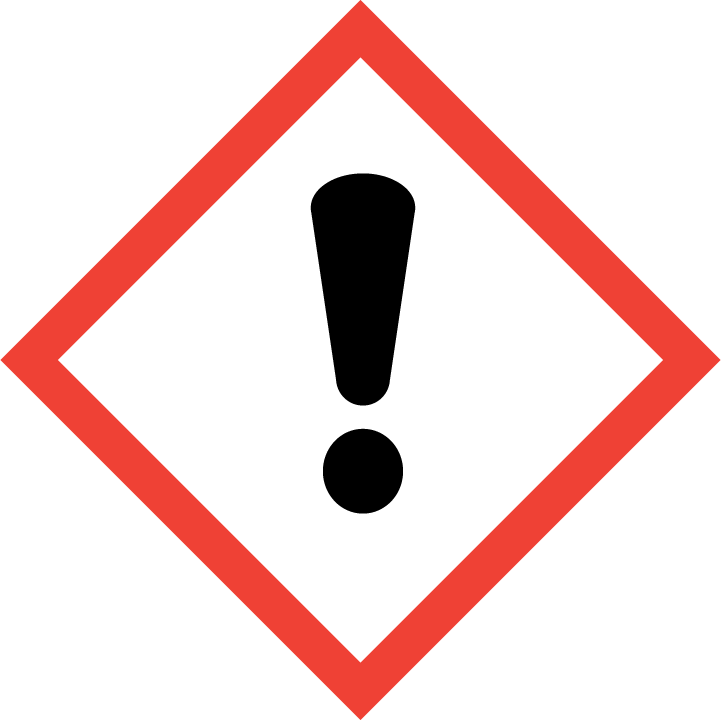
- Signal Words
- Warning
- Hazard Statement(s)
- H315 Causes skin irritation.
- H319 Causes serious eye irritation.
- H335 May cause respiratory irritation.
- Precautionary Statement(s)
- Prevention
- Wash face, hands and any exposed skin thoroughly after handling.
- Wear protective gloves/protective clothing/eye protection/face protection.
- Avoid breathing dust/fume/gas/mist/vapors/spray.
- Use only outdoors or in a well-ventilated area.
Primary route(s) of entry
inhalation of dust or airborne particles.
Human Health
- Inhalation
- IF INHALED: Remove person to fresh air and keep comfortable for breathing.
- Call a POISON CENTER or doctor if you feel unwell
- Ingestion
- Not available.
- Eyes
- IF IN EYES: Rinse cautiously with water for several minutes. Remove contact lenses, if present and easy to do. ContinuerinsingIf eye irritation persists: Get medical advice/attention.
- Skin
- IF ON SKIN: Wash with plenty of soap and water
- If skin irritation occurs: Get medical advice/attention
- Take off contaminated clothing
Environment
No further relevant information available.
- Other Hazards
- None identified
3. Composition / Information on Ingredients
| Name | CAS No. | Content (w/w) | Classification |
|---|---|---|---|
| Benzil | 134-81-6 | >95% | Skin Irrit. 2; Eye Irrit. 2; STOT SE 3; H315, H319, H335 |
4. First Aid Measures
- Ingestion
- Never give anything by mouth to an unconscious person. Clean mouth with water and drink afterwards plenty of water. Get medical attention if symptoms occur.
- Inhalation
- If breathed in, move person into fresh air. If not breathing, give artificial respiration. Consult a physician.
- Skin Contact
- Wash off with soap and plenty of water. Consult a physician.
- Eye Contact
- Rinse thoroughly with plenty of water for at least 15 minutes and consult a physician.
- Other Information
- Consult a physician. Show this safety data sheet to the doctor in attendance.
5. Firefighting Measures
Suitable extinguishing equipment
- Fire
- Use water spray, alcohol-resistant foam, dry chemical or carbon dioxide.
- HAZCHEM
- Not available.
Special protective equipment and precautions for fire fighters
- Wear self contained breathing apparatus for fire fighting if necessary.
- Special hazards arising from the substance or mixture: Carbon oxides
6. Accidental Release Measures
- Personal precautions, protective equipment and emergency procedures
- Use personal protective equipment. Avoid dust formation. Avoid breathing vapours, mist or gas. Ensure adequate ventilation. Evacuate personnel to safe areas. Avoid breathing dust.
- Environmental precautions
- Do not let product enter drains.
- Methods and materials for containment and clean up
- Pick up and arrange disposal without creating dust. Sweep up and shovel. Keep in suitable, closed containers for disposal
7. Handling and Storage
- Precautions for safe handling
- Wear personal protective equipment/face protection. Ensure adequate ventilation. Avoid dust formation. Do not get in eyes, on skin, or on clothing. Avoid ingestion and inhalation.
- Conditions for safe storage
- Keep in a dry, cool and well-ventilated place. Keep container tightly closed. IncompatibleMaterials. Strong oxidizing agents.
8. Exposure Controls / Personal Protection
Exposure Standards
- Engineering controls
- Contains no substances with occupational exposure limit values.Handle in accordance with good industrial hygiene and safety practice. Wash hands before breaks and at the end of workday.
Personal protective equipment
- Eye and face protection
- Safety glasses with side-shields conforming to EN166 Use equipment for eye protection tested
- and approved under appropriate government standards such as NIOSH (US) or EN 166(EU).
- Skin protection
- Handle with gloves. Gloves must be inspected prior to use. Use proper glove removal technique (without touching glove's outer surface) to avoid skin contact with this product. Dispose of contaminated gloves after use in accordance with applicable laws and good laboratory practices. Wash and dry hands.
- The selected protective gloves have to satisfy the specifications of EU Directive 89/686/EEC and the standard EN 374 derived from it.
- Full contact
- Material: Nitrile rubber
- Minimum layer thickness: 0.11 mm Break through time: 480 min
- Material tested:Dermatril® (KCL 740 / Aldrich Z677272, Size M)
- Splash contact Material: Nitrile rubber
- Minimum layer thickness: 0.11 mm Break through time: 480 min
- Material tested:Dermatril® (KCL 740 / Aldrich Z677272, Size M)
- data source: KCL GmbH, D-36124 Eichenzell, phone ±49 (0)6659 87300, e-mail sales@kcl.de, test method: EN374
- If used in solution, or mixed with other substances, and under conditions which differ from EN 374, contact the supplier of the CE approved gloves. This recommendation is advisory only and must be evaluated by an industrial hygienist and safety officer familiar with the specific situation of anticipated use by our customers. It should not be construed as offering an approval for any specific use scenario.
- Body protection
- Impervious clothing, The type of protective equipment must be selected according to the concentration and amount of the dangerous substance at the specific workplace.
- Respiratory protection
- For nuisance exposures use type P95 (US) or type P1 (EU EN 143) particle respirator.For higher level protection use type OV/AG/P99 (US) or type ABEK-P2 (EU EN 143) respirator cartridges. Use respirators and components tested and approved under appropriate government standards such as NIOSH (US) or CEN (EU).
9. Physical and Chemical Properties
General information
- Appearance
- Light yellow, dark yellow crystalline
- Odour
- Odorless
- pH
- Not available.
- Vapour Pressure
- Not available.
- Density
- Not available.
- Boiling Point
- 346 - 348 °C / 654.8 - 658.4 °F
- Melting Point
- 94 - 97 °C / 201.2 - 206.6 °F
- Solubility
- 0.5 g/l @20°C
- Specific Gravity of Density
- Not available.
- Flash Point
- 180 °C - closed cup
- Flammable (Explosive) Limits
- Not available.
- Ignition Temperature
- Not available.
- Formula
- C14H10O2
10. Stability and Reactivity
- Reactivity
- No further relevant information available.
- Chemical stability
- Stable under recommended storage conditions.
- Possibility of hazardous reactions
- No further relevant information available.
- Conditions to avoid
- No further relevant information available.
- Incompatible materials
- Strong oxidising agents
11. Toxicological Information
- Acute effects
- LD50 Oral - mouse - > 3,000 mg/kg
- Remarks: Behavioral:Somnolence (general depressed activity).
- Eye contact
- Serious eye damage/eye irritation
- Eyes - rabbit
- Result: Moderate eye irritation - 24 h
- Skin contact
- Skin corrosion/irritation
- Ingestion
- No further relevant information available.
- Inhalation
- May cause respiratory irritation.
- Toxicity and irritation
- No further relevant information available.
12. Ecological Information
- Ecotoxicity
- No further relevant information available.
- Persistence and degradability
- No further relevant information available.
- Bioaccumulative potential
- No further relevant information available.
- Other adverse effects
- No further relevant information available.
13. Disposal Considerations
General information
- Offer surplus and non-recyclable solutions to a licensed disposal company. Contact a licensed professional waste disposal service to dispose of this material. Dissolve or mix the material with a combustible solvent and burn in a chemical incinerator equipped with an afterburner and scrubber.
- Contaminated packaging: Dispose of as unused product.
14. Transport Information
ADG label required
- HAZCHEM
- Not available.
- UN Number
- None.
- Proper shipping name
- Not regulated.
- Transport hazard class
- 0
- Packing group
- None.
- Environmental hazard
- No information available.
- Special precautions for users
- No information available.
- Additional information
- No information available.
15. Regulatory Information
- Poisons Schedule Number
- No information available.
- Other Information
- No further information available.
16. Other Information
- SDS preparation date
- 12 October 2026
- Comments
- This information is based on our present knowledge. However, this shall not constitute a guarantee for any specific product features and shall not establish a legally valid contractual relationship.
- References
- ThermoFisher Scientific SDS "Benzil". 18/12/2025
- https://www.fishersci.com/store/msds?partNumber=AC105411000&productDescription=BENZIL+100GR&vendorId=VN00032119&countryCode=US&language=en