
Safety Data Sheets / Australian Biostain Gram Stain Kit - Decolouriser
Safety Data Sheet
Australian Biostain Gram Stain Kit - Decolouriser
1. Identification
Product Identifiers
- Product Name
- Australian Biostain Gram Stain Kit - Decolouriser
- Other Names
- N/A
- Product Number(s)
- AGK - GRAM DECOLOURISER
- CAS Number
- 37348-17-7
Recommended use of the chemical and restriction on use
Laboratory use. General laboratory solvent, and reagent for Gram stain techniques.
Company Details
ProSciTech Pty Ltd
11 Carlton Street
KIRWAN QLD 4817
Australia
(07) 4773 9444
pst@proscitech.com
proscitech.com.au
11 Carlton Street
KIRWAN QLD 4817
Australia
(07) 4773 9444
pst@proscitech.com
proscitech.com.au
Emergency Contact Details
ProSciTech Pty Ltd
11 Carlton Street
KIRWAN QLD 4817
Australia
(07) 4773 9444
pst@proscitech.com
proscitech.com.au
11 Carlton Street
KIRWAN QLD 4817
Australia
(07) 4773 9444
pst@proscitech.com
proscitech.com.au
2. Hazards Identification
Classification of the substance or mixture
- Flammable liquids (Category 2), H225
- Serious eye damage/eye irritation (Category 2), H319
- Specific target organ toxicity - single exposure (Category 3), Central nervous system, H336
Label Elements
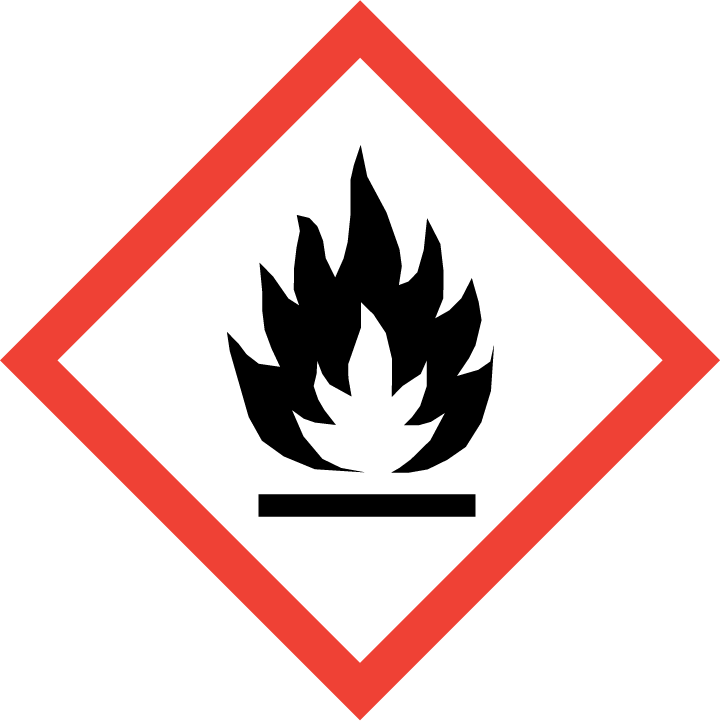

- Signal Words
- None
- Hazard Statement(s)
- H225 Highly flammable liquid and vapour.
- H319 Causes serious eye irritation.
- H336 May cause drowsiness or dizziness.
- Precautionary Statement(s)
- P210 Keep away from heat/ sparks/ open flames/ hot surfaces. No smoking.
- P233 Keep container tightly closed.
- P261 Avoid breathing dust/ fume/ gas/ mist/ vapours/ spray.
- P280 Wear protective gloves/ eye protection/ face protection.
- P303 ± P361 ± P353 IF ON SKIN (or hair): Take off immediately all contaminated clothing. Rinse skin with water/ shower.
- P304 ± P340 ± P312 IF INHALED: Remove person to fresh air and keep comfortable for breathing. Call a POISON CENTER/ doctor if you feel unwell.
- P337 ± P313 If eye irritation persists: Get medical advice/ attention.
- P370 ± P378 In case of fire: Use dry sand, dry chemical or alcohol-resistant foam to extinguish.
- P403 ± P233 Store in a well-ventilated place. Keep container tightly closed.
- P403 ± P235 Store in a well-ventilated place. Keep cool.
Primary route(s) of entry
Repeated exposure may cause skin dryness or cracking
Human Health
- Inhalation
- May cause drowsiness or dizziness
- Ingestion
- No Data
- Eyes
- Causes serious eye irritation.
- Skin
- Repeated exposure may cause skin dryness or cracking
Environment
Prevent further leakage or spillage if safe to do so. Do not let product enter drains.
3. Composition / Information on Ingredients
| Name | CAS No. | Content (w/w) | Classification |
|---|---|---|---|
| acetone | 67-64-1 | >= 50 - < 70 % | Flam. Liq. 2; 2A; STOT SE 3; H225, H319, H336 Concentration limits: >= 20 %: STOT SE 3, H336; |
| ethanol | 64-17-5 | >= 50 - < 70 % | Flam. Liq. 2; 2A; H225, H319 |
4. First Aid Measures
- Ingestion
- Do NOT induce vomiting. Never give anything by mouth to an unconscious person. Rinse mouth with water. Consult a physician.
- Inhalation
- If breathed in, move person into fresh air. If not breathing, give artificial respiration. Consult a physician.
- Skin Contact
- Wash off with soap and plenty of water. Consult a physician.
- Eye Contact
- Rinse thoroughly with plenty of water for at least 15 minutes and consult a physician.
- Other Information
- No data available
5. Firefighting Measures
Suitable extinguishing equipment
- Fire
- Dry powder Dry sand
- Do NOT use water jet.
- Use water spray to cool unopened containers.
- Special hazards arising from the substance or mixture: Carbon oxides
- HAZCHEM
- No Data
Special protective equipment and precautions for fire fighters
Wear self-contained breathing apparatus for firefighting if necessary.
6. Accidental Release Measures
- Personal precautions, protective equipment and emergency procedures
- Use personal protective equipment. Avoid breathing vapours, mist or gas. Ensure adequate ventilation. Remove all sources of ignition. Evacuate personnel to safe areas. Beware of vapours accumulating to form explosive concentrations. Vapors can accumulate in low areas.
- Environmental precautions
- Prevent further leakage or spillage if safe to do so. Do not let product enter drains.
- Methods and materials for containment and clean up
- Contain spillage, and then collect with non-combustible absorbent material, (e.g. sand, earth, diatomaceous earth, vermiculite) and place in container for disposal according to local / national regulations
7. Handling and Storage
- Precautions for safe handling
- Avoid contact with skin and eyes. Avoid inhalation of vapour or mist.
- Conditions for safe storage
- Keep away from sources of ignition - No smoking.Take measures to prevent the build up of electrostatic charge.
- Handle in accordance with good industrial hygiene and safety practice. Wash hands before breaks and at the end of workday.
- Keep container tightly closed in a dry and well-ventilated place. Containers which are opened must be carefully resealed and kept upright to prevent leakage.
8. Exposure Controls / Personal Protection
Exposure Standards
| Material | TWA ppm | TWA mg/m³ | STEL ppm | STEL mg/m³ |
|---|---|---|---|---|
| acetone 67-64-1 | 750 ppm | 1,780 mg/m3 | 1,000 ppm | 2,380 mg/m3 |
| ethanol 64-17-5 | 1000 ppm | 1,880 mg/m3 | - |
- Engineering controls
- Handle in accordance with good industrial hygiene and safety practice. Wash hands before breaks and at the end of workday.
Personal protective equipment
- Eye and face protection
- Face shield and safety glasses Use equipment for eye protection tested and approved under appropriate government standards such as NIOSH (US) or EN 166(EU).
- Skin protection
- Handle with gloves. Gloves must be inspected prior to use. Use proper glove removal technique (without touching glove's outer surface) to avoid skin contact with this product. Dispose of contaminated gloves after use in accordance with applicable laws and good laboratory practices. Wash and dry hands.
- The selected protective gloves have to satisfy the specifications of Regulation (EU)
- 2016/425 and the standard EN 374 derived from it.
- Full contact
- Material: butyl-rubber
- Minimum layer thickness: 0.3 mm
- Break through time: 480 min
- Material tested:Butoject® (KCL 897 / Aldrich Z677647, Size M)
- Splash contact
- Material: butyl-rubber
- Minimum layer thickness: 0.3 mm
- Break through time: 480 min
- Material tested:Butoject® (KCL 897 / Aldrich Z677647, Size M)
- data source: KCL GmbH, D-36124 Eichenzell, phone ±49 (0)6659 87300, e-mail sales@kcl.de, test method: EN374
- If used in solution, or mixed with other substances, and under conditions which differ from EN 374, contact the supplier of the EC approved gloves. This recommendation is advisory only and must be evaluated by an industrial hygienist and safety officer familiar with the specific situation of anticipated use by our customers. It should not be construed as offering an approval for any specific use scenario
- Body protection
- Impervious clothing, Flame retardant antistatic protective clothing., The type of protective equipment must be selected according to the concentration and amount of the dangerous substance at the specific workplace.
- Respiratory protection
- Where risk assessment shows air-purifying respirators are appropriate use a fullface respirator with multi-purpose combination (US) or type ABEK (EN 14387) respirator cartridges as a backup to engineering controls. If the respirator is the sole means of protection, use a full-face supplied air respirator. Use respirators and components tested and approved under appropriate government standards such as NIOSH (US) or CEN (EU)
9. Physical and Chemical Properties
General information
- Appearance
- Liquid, colourless, transparent, volatile
- Odour
- Distinct sweetish.
- pH
- No data available
- Vapour Pressure
- No data available
- Density
- 0.803 g/cm3
- Boiling Point
- 56°C
- Melting Point
- -95°C
- Solubility
- Miscible
- Specific Gravity of Density
- 0.79
- Flash Point
- 20 °C
- Flammable (Explosive) Limits
- Not classified as explosive.
- Ignition Temperature
- No data available
10. Stability and Reactivity
- Reactivity
- No data available
- Chemical stability
- Stable under recommended storage conditions.
- Possibility of hazardous reactions
- No data available
- Conditions to avoid
- Heat, flames and sparks.
- Incompatible materials
- Strong oxidising agents
11. Toxicological Information
- Acute effects
- ACETONE:
- LD50 Oral - Rat - female - 5,800 mg/kg Remarks: (ECHA)
- LC50 Inhalation - Rat - 4 h - 76 mg/l - vapour
- Remarks: Unconsciousness, Drowsiness, Dizziness (External MSDS)
- LD50 Dermal - Rabbit - 20,000 mg/kg Remarks: (IUCLID)
- ETHANOL:
- LD50 Oral - Rat - male and female - 10,470 mg/kg (OECD Test Guideline 401)
- LC50 Inhalation - Rat - male and female - 4 h - 124.7 mg/l - vapour
- (OECD Test Guideline 403)
- Dermal: No data available
- Eye contact
- ACETONE:
- Eyes - Rabbit
- Result: Eye irritation - 24 h
- (Draize Test)
- Remarks: (RTECS)
- ETHANOL:
- Eyes - Rabbit
- Result: Causes serious eye irritation.
- (OECD Test Guideline 405)
- Skin contact
- ACETONE:
- Skin - Rabbit
- Result: Mild skin irritation - 24 h
- (Draize Test)
- Remarks: (RTECS)
- ETHANOL:
- Skin - Rabbit
- Result: No skin irritation - 24 h
- (OECD Test Guideline 404)
- Ingestion
- No data available
- Inhalation
- ACETONE:
- Maximization Test - Guinea pig
- Result: Not a skin sensitiser.
- Remarks: (ECHA)
- Chronic exposure may cause dermatitis.
- Inhalation - May cause drowsiness or dizziness. - Narcotic effects
- ETHANOL:
- Maximization Test - Guinea pig
- Result: negative
- (OECD Test Guideline 406)
- Remarks: (in analogy to similar products)
- The value is given in analogy to the following substances: Methanol
- Toxicity and irritation
- No data available
12. Ecological Information
- Ecotoxicity
- No data available
- Persistence and degradability
- No data available
- Bioaccumulative potential
- No data available
- Other adverse effects
- ACETONE
- Toxicity to fish : flow-through test LC50 - Pimephales promelas (fathead minnow) - 6,210 mg/l - 96 h (OECD Test Guideline 203)
- Toxicity to daphnia and other aquatic invertebrates : static test LC50 - Daphnia pulex (Water flea) - 8,800 mg/l - 48 h
- Remarks: (ECHA)
- Toxicity to algae : static test NOEC - M.aeruginosa - 530 mg/l - 8 d (DIN 38412)
- Remarks: (maximum permissible toxic concentration) (IUCLID)
- Toxicity to bacteria : static test EC50 - activated sludge - 61.15 mg/l - 30 min (OECD Test Guideline 209)
- ETHANOL
- Toxicity to fish : flow-through test LC50 - Pimephales promelas (fathead minnow) - 15,300 mg/l - 96 h (US-EPA)
- Toxicity to daphnia and other aquatic invertebrates : static test LC50 - Ceriodaphnia dubia (water flea) - 5,012 mg/l - 48 h
- Remarks: (ECHA)
- Toxicity to algae : static test ErC50 - Chlorella vulgaris (Fresh water algae) - 275 mg/l - 72 h (OECD Test Guideline 201)
- Toxicity to bacteria : static test IC50 - activated sludge - > 1,000 mg/l - 3 h (OECD Test Guideline 209)
13. Disposal Considerations
General information
Offer surplus and non-recyclable solutions to a licensed disposal company. Burn in a chemical incinerator equipped with an afterburner and scrubber but exert extra care in igniting as this material is highly flammable.
14. Transport Information
ADG label required
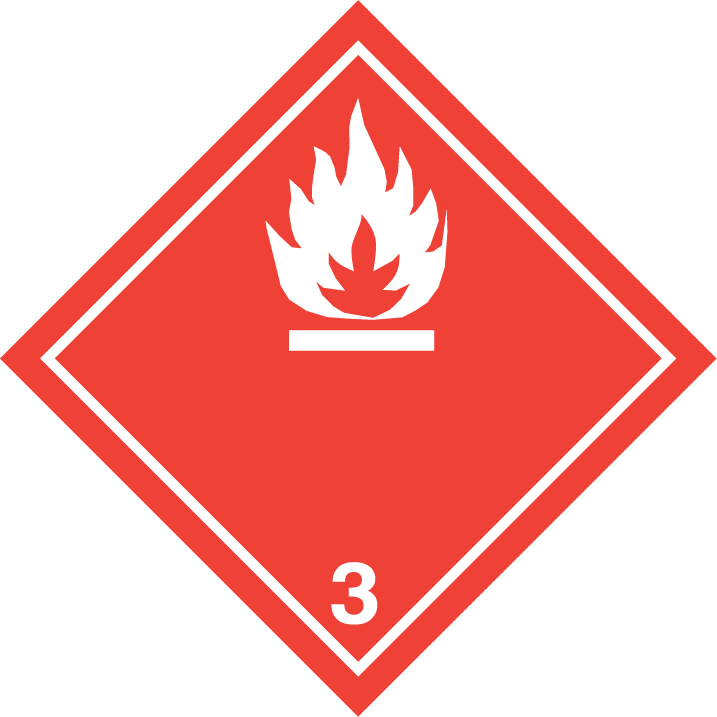
- HAZCHEM
- No Data
- UN Number
- UN1993
- Proper shipping name
- Flammable liquid, n.o.s. (ethanol, acetone)
- Transport hazard class
- 3
- Packing group
- II
- Environmental hazard
- No Data
- Special precautions for users
- No Data
- Additional information
- 3YE
15. Regulatory Information
- Poisons Schedule Number
- No Data
- Other Information
- No Data
16. Other Information
- SDS preparation date
- 24 February 2026
- Comments
- This information is based on our present knowledge. However, this shall not constitute a guarantee for any specific product features and shall not establish a legally valid contractual relationship.This Safety Data Sheet (SDS) has been prepared in compliance with the Preparation of Safety Data Sheets for Hazardous Chemicals Code of Practice February 2016. It is the user's responsibility to determine the suitability of this information for adoption of necessary safety precautions. The information published in this SDS has been compiled from the publications listed in Section 16: to the best of our ability and knowledge these publications are considered accurate. We reserve the right to revise Safety Data Sheets as new information becomes available. Copies may be made for non-profit use.