
Safety Data Sheets / Araldite 502
Safety Data Sheet
Araldite 502
1. Identification
Product Identifiers
- Product Name
- Araldite 502
- Other Names
- Renlam® M-1 CI, Renlam M1
- Product Number(s)
- 10900, 10900-SP, 10900-SPgal, 13900-5G., 13900-SP, C041
- CAS Number
- 84-74-2
Recommended use of the chemical and restriction on use
Laboratory use. Chemical
Company Details
ProSciTech Pty Ltd
11 Carlton Street
KIRWAN QLD 4817
Australia
(07) 4773 9444
pst@proscitech.com
proscitech.com.au
11 Carlton Street
KIRWAN QLD 4817
Australia
(07) 4773 9444
pst@proscitech.com
proscitech.com.au
Emergency Contact Details
ProSciTech Pty Ltd
11 Carlton Street
KIRWAN QLD 4817
Australia
(07) 4773 9444
pst@proscitech.com
proscitech.com.au
11 Carlton Street
KIRWAN QLD 4817
Australia
(07) 4773 9444
pst@proscitech.com
proscitech.com.au
2. Hazards Identification
Classification of the substance or mixture
HAZARDOUS SUBSTANCE. DANGEROUS GOODS.
Label Elements
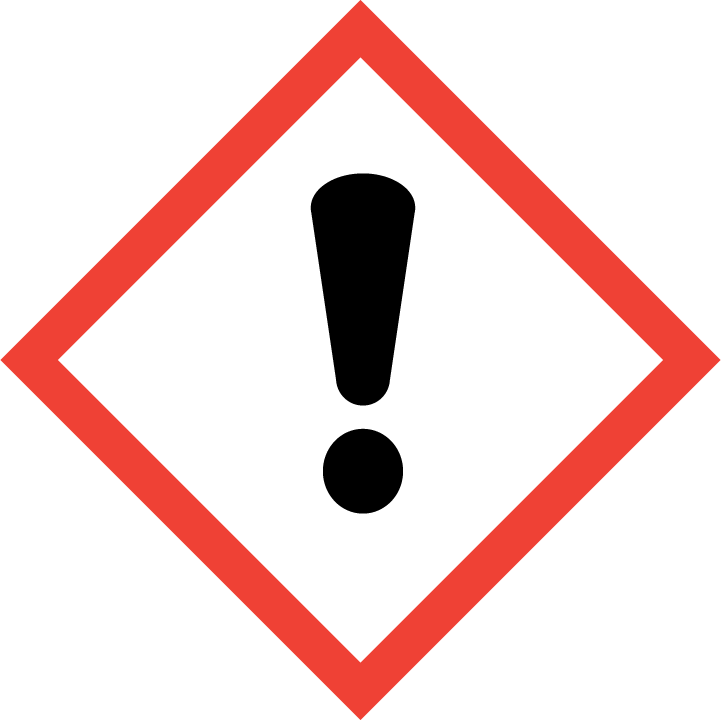
- Signal Words
- Warning
- Hazard Statement(s)
- Skin corrosion/irritation - Category 2 H315 Causes skin irritation.
- Eye damage/irritation - Category 2A H319 Causes serious eye irritation.
- Skin sensitisation - Category 1 H317 May cause an allergic skin reaction.
- Precautionary Statement(s)
- Causes skin irritation.
- Causes serious eye irritation.
- May cause an allergic skin reaction.
Primary route(s) of entry
Not available.
Human Health
- Inhalation
- Not available.
- Ingestion
- Not available.
- Eyes
- Rinse cautiously with water for several minutes. Remove contact lenses, if present and easy to do.
- Continue rinsing.
- If eye irritation persists: Get medical advice/attention.
- Skin
- If skin irritation or rash occurs: Get medical advice/attention.
Environment
Dispose of contents/container in accordance with local/regional/national/international regulations.
3. Composition / Information on Ingredients
| Name | CAS No. | Content (w/w) | Classification |
|---|---|---|---|
| Reaction product: bisphenol A-(epichlorhydrin); epoxy resin (numberaverage molecular weight ≤700 | 25068-38-6 | >50-≤100% | - |
| diethyl phthalate | 84-66-2 | >10-≤25% | - |
4. First Aid Measures
- Ingestion
- Wash out mouth with water. Remove dentures if any. If material has been swallowed and the exposed person is conscious, give small quantities of water to drink. Stop if the exposed person feels sick as vomiting may be dangerous. Do not induce vomiting unless directed to do so by medical personnel. If vomiting occurs, the head should be kept low so that vomit does not enter the lungs. Get medical attention if adverse health effects persist or are severe. Never give anything by mouth to an unconscious person. If unconscious, place in recovery position and get medical attention immediately. Maintain an open airway. Loosen tight clothing such as a collar, tie, belt or waistband.
- Inhalation
- Remove victim to fresh air and keep at rest in a position comfortable for breathing. If breathing is irregular or if respiratory arrest occurs, provide artificial respiration or oxygen by trained personnel. It may be dangerous to the person providing aid to give mouth-to-mouth resuscitation. Get medical attention if adverse health effects persist or are severe. If unconscious, place in recovery position and get medical attention immediately.
- Maintain an open airway. Loosen tight clothing such as a collar, tie, belt or waistband.
- Skin Contact
- Wash contaminated skin with soap and water and rinse throughly. Wash contaminated clothing and shoes thoroughly with water before removing it, or wear gloves. Continue to rinse for at least 10 minutes. Get medical attention. In the event of any complaints or symptoms, avoid further exposure. Wash clothing before reuse.
- Clean shoes thoroughly before reuse.
- Eye Contact
- Immediately flush eyes with plenty of water for at least 15 minutes, occasionally lifting the upper and lower eyelids.
- Check for and remove any contact lenses. Continue to rinse for at least 10 minutes. Get medical attention.
- Other Information
- No further relevant information available.
5. Firefighting Measures
Suitable extinguishing equipment
- Fire
- Use fire extinguishing methods suitable to surrounding conditions and environment
- Large Fire
- Use fire extinguishing methods suitable to surrounding conditions.
- HAZCHEM
- Not available
Special protective equipment and precautions for fire fighters
Not available
6. Accidental Release Measures
- Personal precautions, protective equipment and emergency procedures
- Evacuate surrounding areas. Keep unnecessary and unprotected personnel from entering. Do not touch or walk through spilt material. Avoid breathing vapour or mist. Provide adequate ventilation. Wear appropriate respirator when ventilation is inadequate. Put on appropriate personal protective equipment (see Section 8).
- Avoid dispersal of spilt material and runoff and contact with soil, waterways, drains and sewers.
- Environmental precautions
- Inform the relevant authorities if the product has caused environmental pollution (sewers, waterways, soil or air). May be harmful to the environment if released in large quantities.
- Methods and materials for containment and clean up
- Stop leak if without risk. Move containers from spill area. Approach the release from upwind. Prevent entry into sewers, water courses, basements or confined areas. Contain and collect spillage with non-combustible, absorbent material e.g. sand, diatomite, acid binders, universal binders, sawdust) and place in container for disposal according to local regulations. Dispose of via a licensed waste disposal contractor. Contaminated absorbent material may pose the same hazard as the spilt product.
7. Handling and Storage
- Precautions for safe handling
- Ensure good ventilation/exhaustion at the workplace.
- Prevent formation of aerosols.
- Information about fire - and explosion protection: No special measures required.
- Conditions for safe storage
- Requirements to be met by storerooms and receptacles: No special requirements.
- Information about storage in one common storage facility: Not required.
- Further information about storage conditions: Keep container tightly sealed.
- Specific end use(s) No further relevant information available.
8. Exposure Controls / Personal Protection
Exposure Standards
- Engineering controls
- No further data; see section 7..
- Ingredients with limit values that require monitoring at the workplace: 84-66-2 diethyl phthalate
- WES Long-term value: 5 mg/m³
Personal protective equipment
- Eye and face protection
- Safety eyewear complying with an approved standard. Refer to Australian/New Zealand Standard AS/NZS 1337:1992 for guidance on selection and use of protective eyeware.
- Skin protection
- Protective gloves
- The glove material has to be impermeable and resistant to the product/ the substance/ the preparation.
- Due to missing tests no recommendation to the glove material can be given for the product/ the preparation/ the chemical mixture.
- Selection of the glove material on consideration of the penetration times, rates of diffusion and the degradation.
- Material of gloves
- The selection of the suitable gloves does not only depend on the material, but also on further marks of quality and varies from manufacturer to manufacturer. As the product is a preparation of several substances, the resistance of the glove material can not be calculated in advance and has therefore to be checked prior to the application.
- Penetration time of glove material.
- The exact break through time has to be found out by the manufacturer of the protective gloves and has to be observed.
- Body protection
- Personal protective equipment for the body should be selected based on the task being performed and the risks involved and should be approved by a specialist before handling this product.
- Respiratory protection
- Use a properly fitted, air-purifying or air-fed respirator complying with an approved standard. Respirator selection must be based on known or anticipated exposure levels, the hazards of the product and the safe working limits of the selected respirator.
- Refer to Australian/New Zealand Standard AS/NZS 1715 and AS/NZS 1716 for guidance on selection and use of respiratory devices.
9. Physical and Chemical Properties
General information
- Appearance
- Light yellow liquid
- Odour
- Slight
- pH
- Not available
- Vapour Pressure
- Not available
- Density
- 1.1 g/cm³ [20°C]
- Boiling Point
- 296.1 °C
- Melting Point
- Not available
- Solubility
- Not miscible or difficult to mix
- Specific Gravity of Density
- Not available
- Flash Point
- Closed cup: 160°C
- Flammable (Explosive) Limits
- Not flammable
- Ignition Temperature
- Not selfigniting
- Formula
- Not available
10. Stability and Reactivity
- Reactivity
- No further relevant information available
- Chemical stability
- The product is stable if used according to specifications.
- Possibility of hazardous reactions
- No dangerous reactions known.
- Conditions to avoid
- No further relevant information available.
- Incompatible materials
- Reactive or incompatible with the following materials: oxidising materials, strong acids, strong bases and strong oxidising agents
11. Toxicological Information
- Acute effects
- Based on available data, the classification criteria are not met.
- Eye contact
- Causes serious eye irritation.
- Skin contact
- Irritating to skin. May cause sensitisation by skin contact. May cause an allergic skin reaction.
- Ingestion
- No further relevant information available
- Inhalation
- No further relevant information available
- Toxicity and irritation
- Germ cell mutagenicity Based on available data, the classification criteria are not met.
- Carcinogenicity Based on available data, the classification criteria are not met.
- Reproductive toxicity Based on available data, the classification criteria are not met.
- STOT-single exposure Based on available data, the classification criteria are not met.
- STOT-repeated exposure Based on available data, the classification criteria are not met.
- Aspiration hazard Based on available data, the classification criteria are not met.
12. Ecological Information
- Ecotoxicity
- Toxic for fish
- Persistence and degradability
- No further relevant information available
- Bioaccumulative potential
- No further relevant information available
- Other adverse effects
- Water hazard class 2 (Self assessment): hazardous for water. Do not allow product to reach gound water, water course or sewage systemsDanger to drinking water even if small quantities leak intothe ground. Also poisonous to fish and plankton in water bodies. Toxic for aquatic organisms.
13. Disposal Considerations
General information
- Recommendation
- Must not be disposed together with household garbage. Do not allow product to reach sewage system.
- Uncleaned packaging:
- Recommendation: Disposal must be made according to official regulations.
- Recommended cleansing agents: Water, if necessary together with cleansing agents.
14. Transport Information
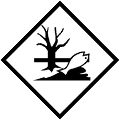
ADG label required

- HAZCHEM
- Not available
- UN Number
- UN3082
- Proper shipping name
- ADG 3082 ENVIRONMENTALLY HAZARDOUS SUBSTANCE,
- LIQUID, N.O.S. (reaction product: bisphenol-A-(epichlorhydrin) epoxy resin (number average molecular weight ≤ 700))
- IMDG ENVIRONMENTALLY HAZARDOUS SUBSTANCE,
- LIQUID, N.O.S. (reaction product: bisphenol-A- (epichlorhydrin) epoxy resin (number average molecular weight ≤ 700)), MARINE POLLUTANT
- IATA ENVIRONMENTALLY HAZARDOUS SUBSTANCE, LIQUID, N.O.S. (reaction product: bisphenol-A-(epichlorhydrin) epoxy resin (number average molecular weight ≤ 700))
- Transport hazard class
- ADG, IMDG, IATA
- Class: 9 Miscellaneous dangerous substances and articles.
- Label: 9
- Packing group
- PG III
- Environmental hazard
- Environmental hazards: Product contains environmentally hazardous substances:
- reaction product: bisphenol-A-(epichlorhydrin) epoxy resin (number average molecular weight <= 700).
- Marine pollutant: Symbol (fish and tree)
- Special marking (ADG): Symbol (fish and tree)
- Special precautions for users
- Special precautions for user Warning: Miscellaneous dangerous substances and articles.
- Hazard identification number (Kemler code): 90
- EMS Number: F-A,S-F
- Stowage Category A
- Additional information
- ADG
- Limited quantities (LQ) 5L
- Excepted quantities (EQ) Code: E1
- Maximum net quantity per inner packaging: 30 mL
- Maximum net quantity per outer packaging: 1000 mL
- Transport category 3
- IMDG
- Limited quantities (LQ) 5L
- Excepted quantities (EQ) Code: E1
- Maximum net quantity per inner packaging: 30 mL
- Maximum net quantity per outer packaging: 1000 mL
- UN "Model Regulation": U N 3 0 8 2 E N V I R O N M E N T A L L Y H A Z A R D O U S SUBSTANCE, LIQUID, N.O.S. (REACTION PRODUCT: BISPHENOL-A-(EPICHLORHYDRIN) EPOXY RESIN (NUMBER AVERAGE MOLECULAR WEIGHT ≤ 700)), 9, III
15. Regulatory Information
- Poisons Schedule Number
- No further relevant information available
- Other Information
- Australian Inventory of Industrial Chemicals
- All ingredients are listed.
- Standard for the Uniform Scheduling of Medicines and Poisons
- 84-66-2 diethyl phthalate S10
- Australia: Priority Existing Chemicals
- 84-66-2 diethyl phthalate
- GHS label elements The product is classified and labelled according to the Globally Harmonised System (GHS).
16. Other Information
- SDS preparation date
- 21 April 2026
- Comments
- Abbreviations and acronyms:
- ADR: Accord relatif au transport international des marchandises dangereuses par route (European Agreement Concerning the International
- Carriage of Dangerous Goods by Road)
- IMDG: International Maritime Code for Dangerous Goods
- IATA: International Air Transport Association
- EINECS: European Inventory of Existing Commercial Chemical Substances
- ELINCS: European List of Notified Chemical Substances
- CAS: Chemical Abstracts Service (division of the American Chemical Society)
- VOC: Volatile Organic Compounds (USA, EU)
- PBT: Persistent, Bioaccumulative and Toxic
- vPvB: very Persistent and very Bioaccumulative
- Skin corrosion/irritation - Category 2: Skin corrosion/irritation - Category 2
- Eye damage/irritation - Category 2A: Serious eye damage/eye irritation - Category 2A
- Skin sensitisation - Category 1: Skin sensitisation - Category 1
- References
- SDS EMS Araldite GY 502. 16/01/2025 https://www.emsdiasum.com/docs/technical//msds/10900.pdf